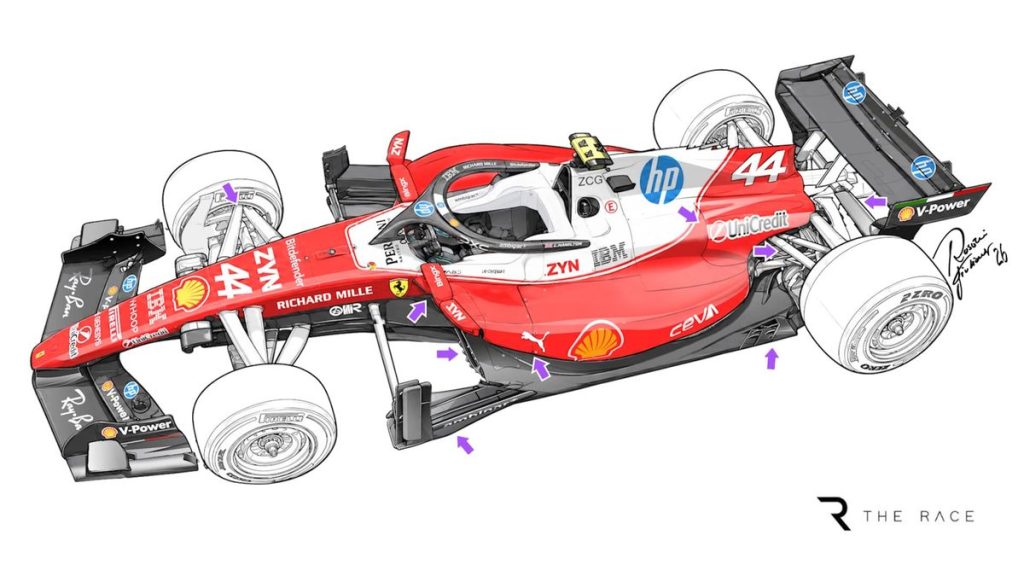
Ferrari is preparing to introduce what will be its fourth and most significant aerodynamic upgrade package of the 2026 Formula 1 season at the United States Grand Prix.
The Austin upgrade is the final development package of this scale planned for the SF-26, while attention at Maranello has now largely shifted towards the development of next year’s car, which will be completely different, both due to regulatory restrictions and fundamental aerodynamic choices.
The updates at the Circuit of the Americas will affect several areas of the car, with modifications to the floor, sidepods and upper bodywork.
New bodywork
Unlike some of its main rivals, according to our information, Ferrari has decided not to radically change the aerodynamic concept of its sidepods.
McLaren and Mercedes, the latter in particular, have recently made significant changes to their concepts with their latest upgrades, substantially modifying the shapes and the way airflow travels along the sidepods. Neither team appears to have immediately achieved on track what it had seen in the windtunnel and CFD simulations.
Ferrari, on the other hand, has preferred to maintain greater continuity with the SF-26’s current architecture.
It is understood to have worked mainly on optimising its existing solutions, without making fundamental changes to the bodywork. The main objective is believed to be reducing drag, as the SF-26 still suffers somewhat in this area. (Which is not helped by Ferrari’s less-powerful engine.)
The team has therefore preferred a less invasive solution, seeking to maximise the potential of the current design while weighing up the performance gains against the resources needed to achieve them.
The new bodywork will be accompanied by modifications to the cooling louvres, adapting hot-air extraction to the new sidepod geometries. Further cooling configurations are planned for the following Mexican GP, where Ferrari is expected to introduce larger openings to cope with the particularly demanding conditions imposed by the altitude.
A close study of Red Bull’s design
This does not mean that more radical alternatives have not been considered by Ferrari.
During development, numerous iterations were carried out in the windtunnel, exploring different geometries and bodywork concepts, also with the aerodynamic choices for the 2027 project in mind.
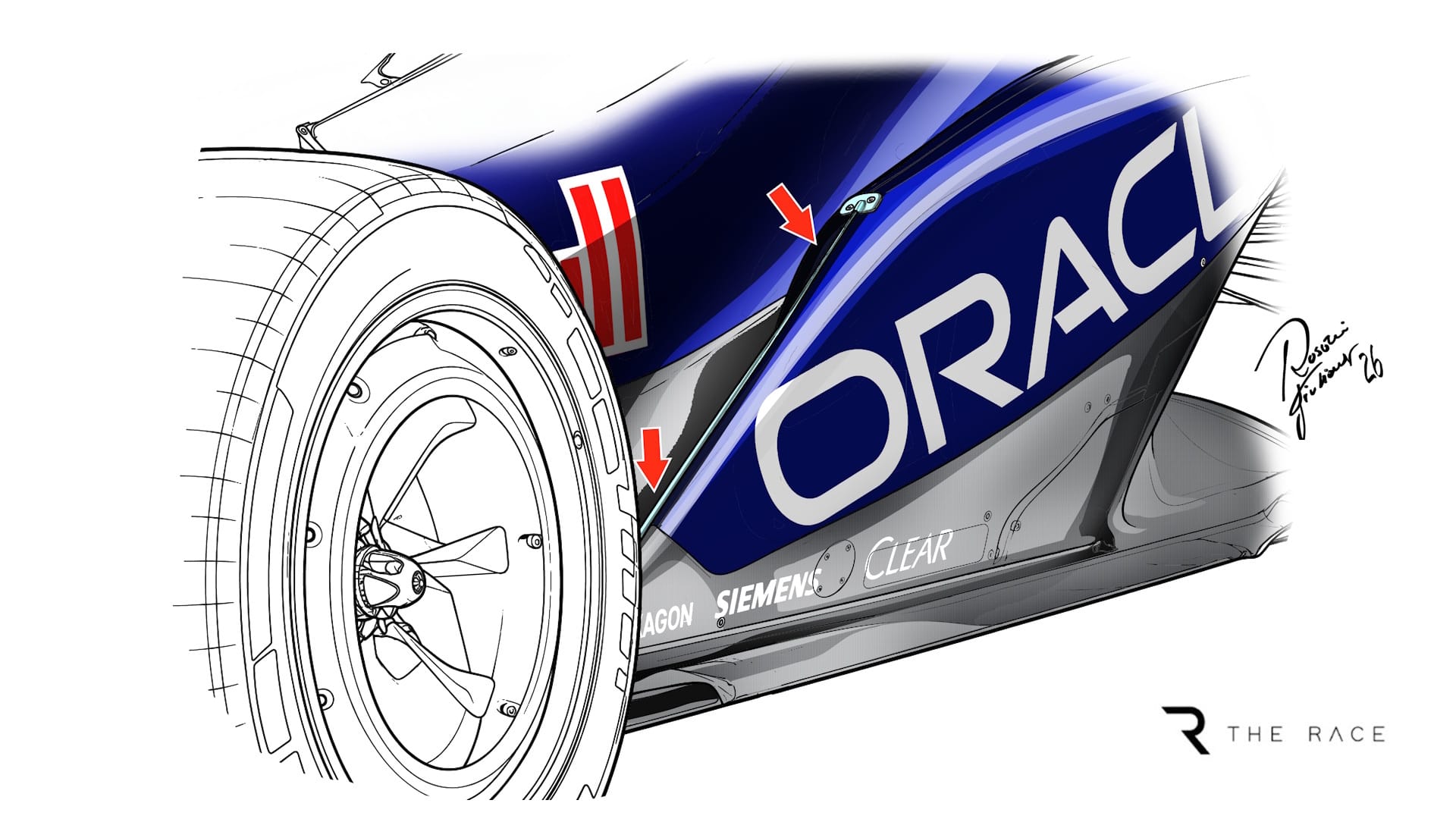
Among the solutions analysed at Maranello during the season was the sidepod design introduced by Red Bull, characterised by an interesting interpretation of the regulations concerning the floor body stays.
On the RB22, and on the Audi from Baku onwards, the structural stay connecting the floor to the bodywork is also exploited for aerodynamic purposes. Through the fillet between the stay and the sidepod surfaces, Red Bull has managed to define a particularly aggressive geometry, as the current regulations allow a fillet radius of 20mm. This has helped recreate the so-called waterslides, the channels that guide airflow towards the rear of the car.
This solution allows an element that is primarily structural to also influence the shape and aerodynamic behaviour of the bodywork.
Ferrari carefully examined and evaluated this concept, but decided not to devote a significant proportion of its resources to such a substantial transformation of the SF-26’s sidepods.
The decision was mainly a matter of development priorities.
A substantial change to the sidepod philosophy would have required integration work with the rest of the aerodynamic platform, particularly the floor, without any certainty of obtaining a sufficiently significant advantage in the few remaining races.
At Maranello, the preference was therefore to concentrate efforts on another area, still considered to offer the greatest performance potential: the floor.
The main focus of the Austin package
As for the new floor, the changes will not be limited to a single area, but will involve a more extensive revision of the entire system, from the front section through to the diffuser.
The decision to continue investing in this component is also linked to the results obtained with the previous package introduced at Zandvoort.
The development brought to the Netherlands followed Ferrari’s failure to identify particularly significant opportunities for improvement in the short term, prompting the team to continue working on the floor geometry in search of a more substantial gain specifically for Austin.
The SF-26 has shown a good underlying design throughout the season, but the engineers have continued to seek an increase in the performance generated by the underside of the car.
The new Austin floor has been developed not only with the aim of increasing downforce, but also of addressing the aerodynamic balance, which is still too heavily biased towards the front, and widening the operating window, as Red Bull has somewhat managed to do.
The end of SF-26 development
The US GP will be the final event at which Ferrari introduces an aerodynamic package of this significance. After Austin, development of the SF-26 will be mainly limited to circuit-specific adaptations.
Ferrari has also used the numerous windtunnel iterations to explore different design directions for 2027, when the new car will feature substantially different aerodynamic solutions compared to the SF-26.
The future Ferrari will nevertheless retain some elements of continuity with the current project, particularly regarding the chassis, which has been one of the most convincing aspects of the 2026 car, while work on the 2027 power unit continues in parallel.
Austin will also provide an opportunity to verify the correlation between the results obtained from development tools and the car’s behaviour on track.