U.S. Short Course World Trials: Teammates Pushing Each Other Toward World Records as ‘Iron Sharpens Iron’
As much of an individual sport as swimming is, it is also a team sport.
It doesn’t have to be a college meet for teammates to reap the benefits of having each other.
Teammates facing off with a national title or even an Olympic medal has become commonplace in the U.S. – and it has been on full display at the 2026 USA Swimming Short Course World Championship Trials in Westmont, Illinois.
It is something directly leading to record-breaking swims for the U.S.
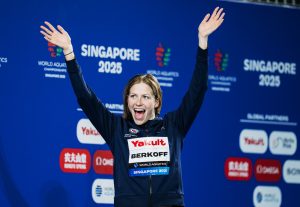
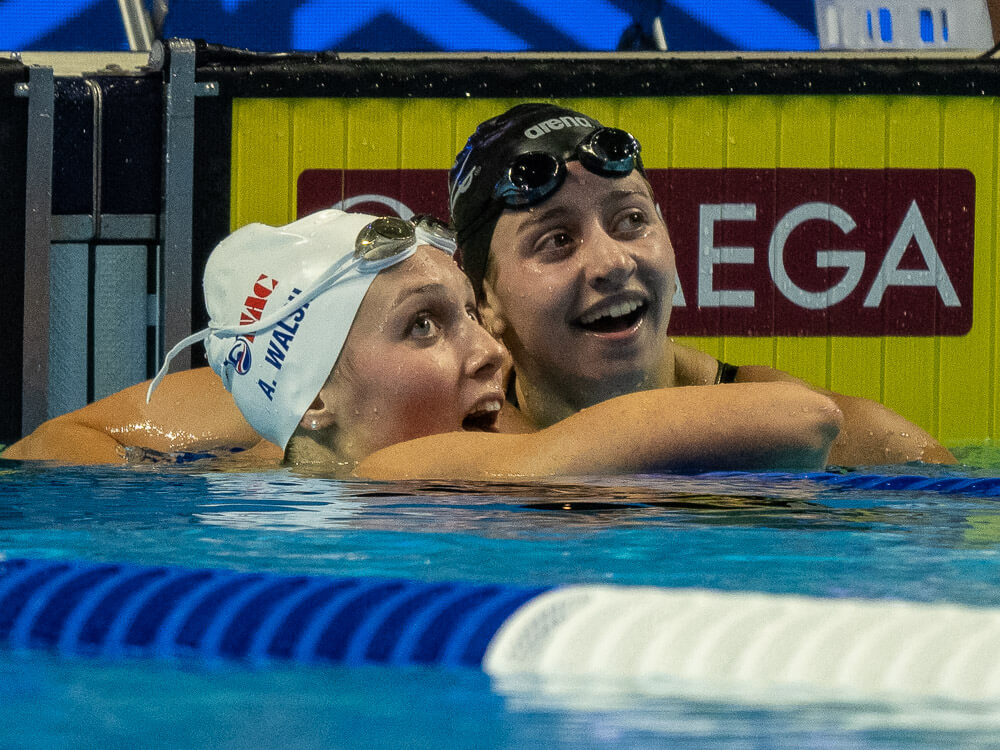
On the first night, Kate Douglass tied the world record set by her teammate Gretchen Walsh in the 50 free. They were in the race together and went 1-2.
Douglass then went head-to-head with Alex Walsh in the breaststroke and went 1-2.
Meanwhile pros Phoebe Bacon and Isabelle Stadden faced training partner Claire Curzan or Douglass or Walsh or both.
“I think the adage of iron sharpens iron is fitting. You look at them and it is crazy. I think it is great that they set the bar so high because it makes you rise to the challenge,” Curzan said.
It isn’t just the Virginia contingent, though they are setting plenty of records.
Cal’s Gabriel Jett and Destin Lasco went 1-2 in the 200 backstroke.
Indiana’s Van Mathias had two fellow Hoosiers in the finals of the 100 breaststroke when he set the world record.
Claire Weinstein went 1-2 with fellow Cal Golden Bear Rylee Erisman in the 400 free.
That was all on Thursday night.
Most of those races saw teammates go 1-2.
It is an interesting dynamic with waves of layers.
Racing teammates on the biggest stages of the sport is familiar and can be comfortable. On the flip side, it can be a lot of pressure to catch your teammate, or touch them out at the finish.
This can naturally lead to feelings of jealousy and make for awkward situations.
But it doesn’t seem to be the case at Virginia or any of the other power teams.
“Always (swim against Lasco). It is an interesting dynamic. It helps me because it feels like practice. I know how Destin swims and how he trains,” Jett said. “It takes all the pressure off and lets me have fun with it.”
What it also does is breed greatness.
Douglass and the Walsh sisters know that there is a real possibility they wouldn’t have gotten to the world record level without the others pushing.
That push worked so well that it is starting to attract pros like Bacon and Stadden.
Texas Longhorn Aquatics has a load of talent with Regan Smith, Luke Hobson, Simone Manuel and several international superstars.
There are smaller hubs of elite swimmers around the country at Sandpipers, Wolfpack, Stanford, Michigan, Indiana and Tennessee and a few other places.
“Going to IU made a huge difference because I got to have training partners who were former Olympians, people on the Pan Pac and worlds teams. With that my racing excelled well beyond what I ever thought,” said Josh Bey, who won the 400 IM.
It has been that way for as long as the sport has been a team sport.
Duke Kahanamoku had several strong swimmers in Hawaii with him, including his brother, that pushed the level.
Mark Spitz was on an Indiana team that was loaded.
Tom Dolan had Eric Namesnik and others to push him at Michigan.
Allison Schmitt had Kara Lynn Joyce, then Shannon Vreeland at Georgia.
More recently, Katie Ledecky had Simone Manuel and Ella Eastin to push her at Stanford.
Maggie MacNeil had Olivia Carter in Ann Arbor pushing the butterfly events as both became NCAA champions.
There are plenty of other examples out there, but these are world record swimmers who had other record-holders or championship contenders to push them to greatness.
It bunches the world-level talent a bit on the college scene, but as long as the major hubs continue to produce multiple contenders at a national level, the U.S. is going to get faster – and faster.