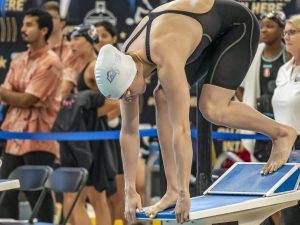
With Friday’s announcement that British Olympic and World Champion Matt Richards would join the University of Florida as a rental for the spring semester, the Gators have their replacement, in spirit, for Josh Liendo after he exhausted his eligibility in the spring season.
Florida finished 2nd at last year’s NCAA Championship meet, just 29.5 points behind the University of Texas – making the meet more competitive than likely anyone expected.
But will the mid-season addition of Richards be enough to keep pace with the loaded Longhorns this season?
Let’s break it down.
How Many Points is Richards Worth?
Richards, based on both his long course meters and very good short course meters times, becomes an automatic NCAA contender in both the 100 free (47.45 LCM/45.82 SCM) and 200 free (1:44.30 LCM/1:41.01 SCM). Aside from the 100 free in SCM, most of those times are a few years old, and he has to work out his stroke counts in yards in very short order, plus adapt to new training while he has bigger goals for the summer, but he’s going to be 24 years old by the time he arrives in Florida and also is one of those ‘next level’ talents who always adapt to short course yards very quickly.
Richards doesn’t have a 3rd event where he obviously contends for titles right away, but again talent rises to the top. He has a best of 21.98 in the 50 free in long course, but surprisingly only a 4:04.95 (from 2018) in the 400 free.
Either the 50 free or 500 free would be clear of direct conflicts with his other individual events. Other possibilities, based on long course results, includes the 100 fly (53.40 long course).
So let’s say he wins a race, gets 2nd in another, and gets 5th in the third. Call it 51 points (probably conservative).
His event lineup makes him very valuable on relays, and he will surely be a four relay swimmer for the Gators.
His ‘replacement value’ on relays is amplified by the fact that the Gators aren’t as deep in the sprints as they once were.
Devin Dilger is their leader so far this season in both the 50 free (19.21) and 100 free (42.11), and there’s a pretty big dropoff after him in both events.
That’s in part because junior Alexander Painter hasn’t raced yet this season for the Gators. Painter was their #2 sprinter last season after Liendo.
Regardless of Painter’s status, Richards’ benefit versus replacement on the free relays is probably worth .7-1.0 seconds on a relay in 50, 2.5-3.0 seconds in a 100, and 3.0-3.5 seconds in a 200. Less so in the medleys, where he’d be replacing a #2 versus a #1 (or not even a clear #1).
The biggest impact will be in the 800 free relay, where the Gators were an uncharacteristic 19th place and out of the points last season in 6:12.93. His presence last year would have put the Gators in the top 10 and at least 14-18 points.
After a full evaluation of his offerings, relay impact could be 40-50 points.
That makes his net impact on the Gators at NCAAs something like 90-100 points. 95 seems like a nice medium-aggressive estimate.
Returning Points
The Gators returned 130 of their 284 individual points from last year’s NCAA Championship meet, while Texas returned 181.5 out of their 284.5 individual points.
So without accounting for the freshman classes and any other transfers, that makes Richards just-shy-of a wash on the Gators’ graduating points. Those graduating points include Liendo, who won the 50 free, 100 free, and 100 fly at NCAAs last year, leading all scorers with 60 individual points.
Back-of-the-napkin, let’s say that leaves the Gators’ 30 point deficit last year at 40 points, all else equal.
That is a gap that could have been made up by South Korean Junwoo Kim, who was committed to the Gators but wound up changing his mind to stay home and train. He was the crowned jewel of the Gator class, at least on the individual side of the pool.
Beyond him, the Gators have some solid additions in the freshman class (Hungarian Zoltan Bagi and South African Tai Pearson had nice meets against Virginia), but no real hammers as swimmers.
They do pick up a very good diver in Miguel Tovar from Colombia and another veteran in 24-year-old David Johnston, a transfer from Texas who last swam in college in 2025.
Johnston is an Olympian, but at his last NCAA Championship meet in 2025 ‘only’ scored 30 points. He’s also a distance swimmer, so that mitigates his relay impact.
So let’s say all of those guys above combine for an impact of 60-80 or so NCAA Championship points.
That puts the Gators up 20-40 on the Longhorns…before accounting for Texas’ newcomers.
Texas brings in freshman Rowan Cox, who had a monster summer; Austin Carpenter, ranked #8 in the class; World Junior Record holding distance swimmer Kuzey Tuncelli; Canadian Age Group Record breaker Laon Kim; Michigan transfer Luka Mladenovic, who scored 30 NCAA points as a breaststroker last year; and an elite diving commit and European Junior Champion Matej Nevescanin.
And if that wasn’t enough, the best mid-distance prospect in the U.S. in several generations Luka Mijatovic and Ian Call will both arrive in Austin at the semester break too.
So that’s 150+ points there, and puts the Longhorns firmly in control of at least this head-to-head, in spite of Richards’ splashy addition.
This move is probably enough to give Florida a realistic shot of overcoming Indiana at NCAAs – depending other whether Indiana’s Owen McDonald and Zalan Sarkany wind up being eligible this year, and pending some injury issues for the Hoosiers.
Conclusion
So for now, I think this move is enough to jump the Gators into #2 in my Power Rankings ballot next week, but leaves Texas firmly as #1. But we live in a wild west of uncertainty and dramatically shifting tides, and it sort of feels like this might not be the end of the movements for college swimming’s three current power brokers.
This all assumes Painter is good-to-go this season, which would have a big impact for the Gators as well.
Texas are counting on points for a lot more guys too, which in theory gives them more buffer from a swimmer or two having a bad meet.
All three programs (Texas, Indiana, Florida) have a penchant for non-traditional roster moves of late (transfers, mid-season additions, etc.), so there may still be more surprises that will impact the ranking this season.