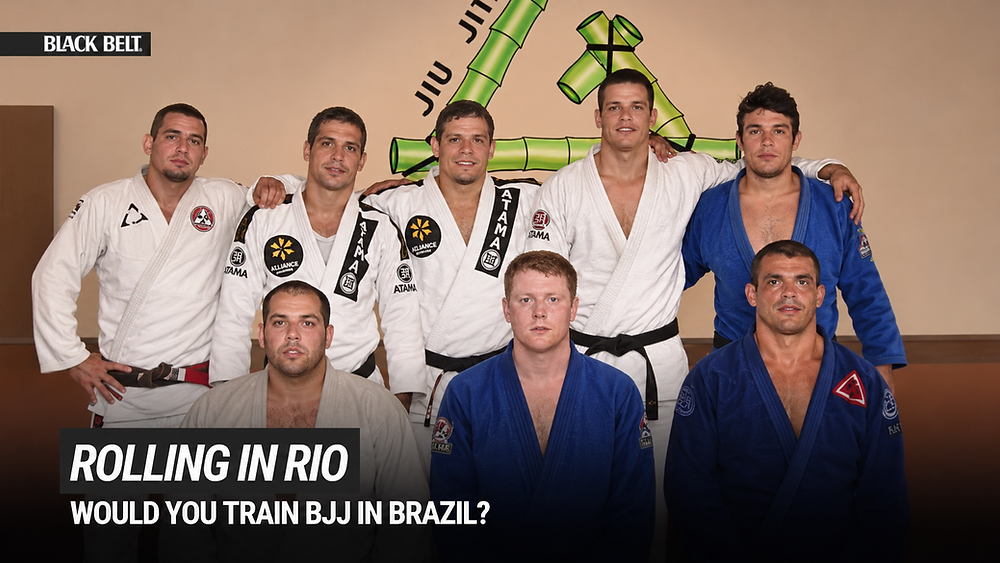
Brazil is the fifth-largest nation in the world. A former colony of Portugal, it derives much of its culture—as well as its religion and language—from its mother country. African traditions also have left their mark on Brazil—witness the dancelike fighting art of capoeira. But the South American nation’s claim to fame in the martial arts world is surely Brazilian jiu-jitsu.
THE FIRST TIME I visited Brazil for training purposes, I had only six months of jiu-jitsu under my belt. Because I was in the soaking-up-information mode, I wore a white belt—which wound up being no problem at all because beginners are welcome in Brazilian dojo. My advice: If you’re new to the art, pace yourself and stay within your comfort zone. Pushing too hard can cause an injury that ruins the rest of your trip.
The following are a few other tips for martial artists who decide that Brazil is the place to fine-tune their grappling skills:
-
KNOW the basic movements, especially breakfalling and rolling, before you go.
-
START stretching as soon as you can. You don’t want to be sidelined by an intensive training session.
-
LEARN the rules of the dojo at which you choose to train. Some facilities have specific regulations for beginners—for example, leg locks may be prohibited.
-
FOLLOW the Brazilian way. Although the atmosphere won’t be as formal as in the typical Asian dojo, you’ll still be expected to address your training partners and teachers with courtesy and respect.
-
RAMP up your cardio. You’ll perform better on the mat and get more from the lessons because you’ll be able to focus on the techniques instead of on catching your breath.
-
STUDY the language. Even if you learn only a few words of Portuguese, your efforts will be appreciated by every local you meet.
MY TRIP TO BRAZIL took me to the Gracie Academy, making it a martial arts pilgrimage of sorts. The dojo is located on the second floor of a Catholic school in downtown Rio de Janeiro. Walking through the gate, I followed my teacher, Louis Vintaloro, up the steps. I wasn’t sure what to expect, but he knew his way around because he’d been to Brazil a few times.
Halfway up the stairs, everything went black. Turns out Rio sometimes loses power during hot spells. It didn’t seem to bother anyone, however. We continued up the stairs, and once inside the school, I noticed all the students were still training. No doubt grappling in the dark fine-tunes tactile senses.
After a few minutes, the power came back on, and life returned to normal. Royler Gracie taught most of the classes at the school. When he was traveling or competing, his brother Rolker would take over. The facility regularly hosts visitors from around the world, so the staff is used to dealing with English-speaking foreigners.
In addition to the techniques I picked up, I also learned some valuable lessons that will stay with me for the rest of my martial arts career. First off: The experience reinforced the fact that the essence of being a martial artist is to never stop seeking knowledge. Don’t fall into the trap of thinking you don’t need to learn new moves or training methods.
It can be intimidating when everyone else in class seems to know more than you, but don’t let your ego get in the way. Making mistakes, forgetting the details, constantly being caught in bad positions—it’s all part of the Brazilian jiu-jitsu experience. And you know what? Nobody cares. The only person keeping track of you is you.
IF YOU’RE READY TO ROLL on the mat in Rio, start making plans now. You’ll need a passport and visa to enter Brazil. Get the passport from your country of residence and snag a basic tourist visa, available from the Brazilian Embassy or a Brazilian Consulate in your country, for a stay of three months or less. For an extra fee, travel agencies can help you obtain one through the mail.
Airline fees tend to discourage travelers from carrying a lot of luggage these days, and that’s fine because the only thing you’ll need is several changes of shorts, a pair of flip-flops and your gi—which, by the way, is called a kimono in Brazil.