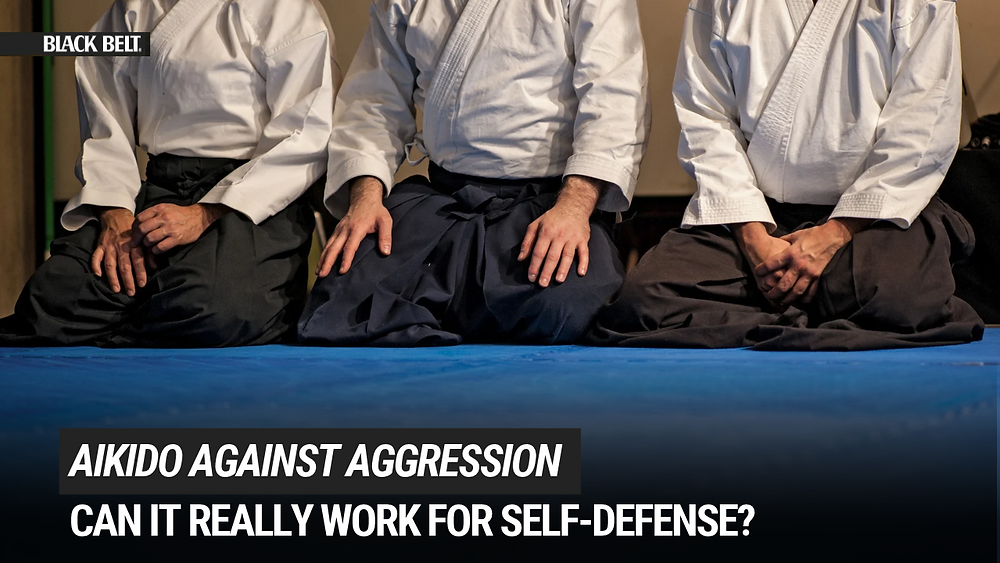
Guillermo Gomez has devoted the past 26 years of his life to perfecting his aikido skills. Rising through the ranks was never his primary concern; mastering the intricacies of all the techniques he was taught in class was vastly more important. Consequently, the fourth-degree black belt that’s wrapped around his waist is the result of old-fashioned sweat equity, not a stint in a strip-mall McDojo that doles out belts on a bimonthly schedule. He earned his rank the hard way, under the tutelage of sixth-dan Nelson Requena of the Venezuela Aikikai in his hometown of Caracas, Venezuela.
Gomez recently dropped by the Black Belt offices to demonstrate his craft for our cameras. We asked him to teach basic aikido defenses even nonpractitioners could use to fend off a choke, a punch, a knife thrust and a front kick. This article is the fruit of that labor.
Choke Defense
The opponent starts with the fingers of his right hand wrapped around the aikidoka’s neck (Photo 1). The man’s left fist is chambered for a head punch. From his ready stance, Gomez executes a right palm strike to the chin, stunning the assailant (Photo 2). He then positions his right hand over the back of the choking hand and his left hand on the elbow (Photo 3 and inset).
“This technique works because I control the thumb,” Gomez says. “I use my right hand, along with the rotation of my body, to put pressure on his wrist until he releases the choke.” His grip on the knife edge of the choking hand augments the leverage he applies to the offending appendage.
Using his left hand to bolster the torsion that stems from the wrist lock, Gomez rolls the man’s arm over and pushes down on the elbow (Photo 4). That creates a momentary standing armbar.
Next, Gomez circles his left arm under the locked limb, securing it in the crook of his elbow (Photo 5). He uses his forearm to drag the elbow outward, bending the arm until it’s shaped like a “Z” (Photo 6). The aikidoka keeps the pressure on, courtesy of the wrist lock, while he uses his left hand to force the angled arm—and the man—to the ground (Photo 7). Once he’s down, Gomez moves his left hand to the man’s right elbow and guides the arm into a straightened orientation so he can apply pressure to the joint (Photo 8). The pain causes the opponent to hit the mat.
Gomez immediately kneels, placing one knee on each side of the man’s shoulder (Photo 9). After using his forearms to trap the limb against his torso, he grabs the fingers of the opponent’s right hand and hyperextends them (Photo 10). Note how his left forearm, which he’s moved upward until it rests against the back of the man’s hand, serves as a fulcrum for the action.
Essential principle: This technique relies on nikyo, the second immobilization technique of aikido, Gomez says. “It enables me to control the wrist, after which I bend the elbow and use my hips and the rotation of my body to put more pressure on it.”
Punch Defense
PACIFYING THE PUNCH
The assailant uncorks a shot, and Gomez uses his left forearm to block the blow—specifically by making contact with the man’s forearm (Photos 1-2). The aikidoka moves off the centerline and executes a quick atemi (strike) to the face (Photo 3).
Gomez seizes the wrist with both hands and pulls it to extend the arm (Photo 4). Before he maneuvers the limb into a position that will allow him to duck under it, he applies upward pressure on the back of the elbow with his shoulder/upper arm (Photo 5). Then he passes underneath and bends the arm, moving the palm toward the associated shoulder (Photo 6). Acute pressure on the wrist and shoulder causes the man to fall backward in an effort to alleviate the pain (Photo 7).
When the opponent lands on his back, Gomez maintains his hold on the wrist, which keeps the limb bent (Photo 8). Using his right shin, he pushes the man’s body away, which angles the arm in such a way that the pain is amplified (inset). “To finish, I lift the wrist, which adds even more pressure to it and the arm,” Gomez says (Photo 9).
Essential principle: This technique uses shiho nage, aikido’s “four-direction throw.” The opponent’s trapped hand is raised in a painful manner, thus allowing the martial artist to circle underneath before sending him to the mat.
Knife Defense
NEUTRALIZING THE KNIFE
Holding the edged weapon in his right hand, the opponent begins to thrust it toward Gomez’s abdomen (Photo 1). The aikidoka scoots offline and to the outside, and as the assailant’s arm extends, Gomez grabs his forearm with his right hand (Photo 2). At the same time, he uses his left forearm to apply momentary pressure on the elbow area.
Next, Gomez grabs the man’s wrist with his left hand, which enables him to reverse the motion and swing the straightened arm down and to the rear (Photo 3). Once the limb is sufficiently high, Gomez circles under it (Photos 4-5) and halts the travel of the weapon in an awkward position—the elbow is high, the wrist is angled in toward the opponent’s body and the wielder is on his toes in response to the pain being inflicted (Photo 6). All that facilitates the disarm (Photo 7 and inset).
Opting for a nonlethal response, Gomez uses the spine of the blade to apply pressure on the side of the elbow, while his left hand maintains a lock on the right wrist (Photo 8). He takes the opponent down, at which point he has the option of using the knife offensively (Photo 9). Not wishing to spill his foe’s blood, Gomez effects a standing control that entails using his left knee and shin to hyperextend the trapped arm (Photo 10). Note how he leans forward to inflict the pain; he doesn’t try to do it by moving his foot.
Essential principle: This technique utilizes sankyo, aikido’s third immobilization technique. It involves twisting the wrist while the forearm is held vertically.
Kick Defense
CONTROLLING THE KICK
The opponent launches a midlevel front kick (Photos 1-2). Having detected it, Gomez darts to the outside and uses his right arm to check the leg (Photo 3). Note how he keeps his left arm near his face for protection in case he’s wrong about the nature of the attack (Photo 4). The aikidoka allows the man to step forward after the kick (Photo 5), then circles his right arm down and back until it’s in front of the opponent (Photo 6). Gomez swings his arm into the face of the opponent, allowing his elbow to bend as the impact happens (Photo 7).
Meanwhile, Gomez places his right leg and hip behind the man so he can’t step backward to maintain his balance when the arm makes contact. That enhances the effect of the technique by augmenting the rotational force of the blow, thus causing him to fall flat on his back or even hit the ground headfirst instead of merely landing on his butt (Photo 8).
“The same motion I use to protect myself from the kick is what takes him down,” Gomez says. “It is a hit, and a bad one.”
Essential principle: In aikido, irimi nage means “entering throw.” The martial artist invades the opponent’s space before taking control of his body and slamming him to the mat. “This is the throw Steven Seagal used in his movies,” Gomez says.
Words of Aikido Wisdom
One of Guillermo Gomez’s favorite aikido quotes comes from—no surprise—Morihei Ueshiba, the art’s founder: “Iron is full of impurities that weaken it; through forging, it becomes steel and is transformed into a razor-sharp sword. Human beings develop in the same fashion.”