“If it disagrees with experiment, it is wrong. In that simple statement is the key to science. It doesn’t make any difference how beautiful your guess is, how smart you are, who made the guess or what his name is. If it disagrees with experiment, it’s wrong. That’s all there is to it.” —Richard Feynman, Nobel Prize-winning physicist
That’s one heavy-duty, says-it-all quote from a brilliant man. Nothing I say will better it, but I’ll do my best to apply that bit of wisdom to the world of human beings who like to smack and squeeze each other into submission. Specifically, how can you think like Feynman when you’re drilling?
In the past, when discussing martial arts training, I’ve used the analogy of a train, a locomotive that stays on track, chugging toward its destination. I likened anything that forces you to skip or that hamstrings your training to a derailment. That analogy still holds—the discipline portion of it, that is.
STAYING WITH ANALOGIES, drilling entails boring into material until you punch through the other side, literally piercing the subject matter. Actual drilling, in the mechanical sense, is accomplished via a rotating bit that’s applied with pressure. Metaphorical drilling can feel like its real-world correlate: You apply pressure while running through the same physical tasks over and over.
In this sense, drilling and training can be viewed as two words for the same concept.
Combat drilling is often the rote repetition of skills, techniques and responses performed hundreds or thousands of times. Don’t get me wrong: There’s wisdom in this repetition: the wisdom of training, of discipline, of commitment, of staying on track. However, just as literal drilling—when a bit cuts into wood—can be called “boring,” combat drilling done wrong can be boring when its repetitiveness induces boredom.
That presents a dilemma: You need lots of repetitions to seat skills, but passive or disinterested repetition may not be the best or the quickest way to progress. It’s because of this potentially mind-numbing aspect of drilling that you do yourself a service if you embrace the opening quote.
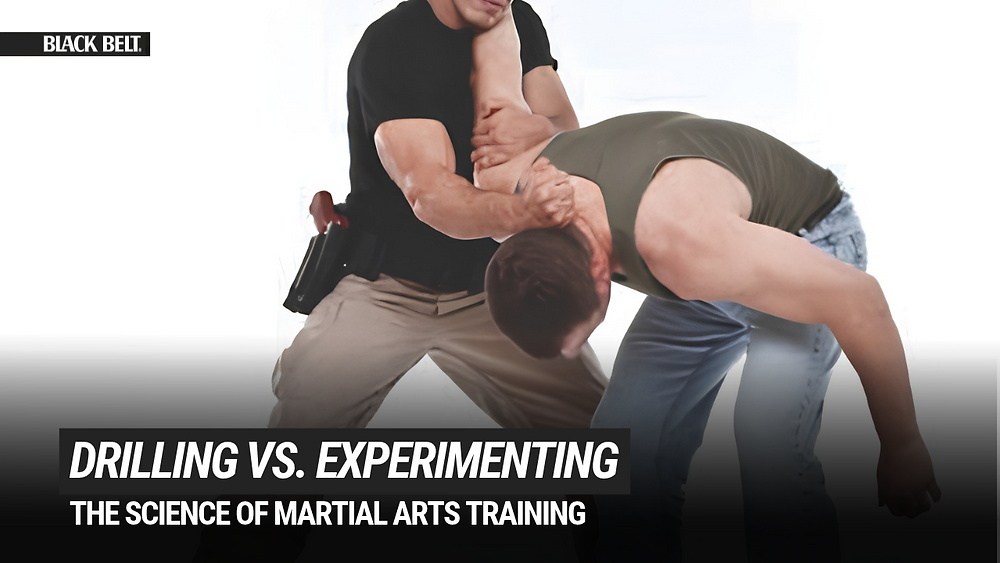
EVERY INDIVIDUAL TECHNIQUE, every isolated tactic or strategy, is an experiment—not an experiment by analogy but an actual experiment. Will this particular combination function in this situation? Will this submission succeed against an opponent this size? Does this gun disarm actually work? All are experiments. By looking at each aspect of drilling and competition as an experiment—one that needs to be monitored at every step—you can reawaken your interest and re-engage your intellect.
You’ll see that throwing 1,000 leg kicks on the banana bag is not a chore; it’s something you pay attention to because you must monitor every kick. Was your hip turned over on that one? What if you shifted your striking surface an inch up? Was your pivot heel too high?
The same applies to grappling: Is your rear-naked choke tighter with your hand on the lowest portion of your biceps or up near your deltoid?
IF YOU APPROACH EVERY training task and drill as an experiment to be monitored, a task to be calibrated, quantified and qualified, you move closer to full engagement with what you’re trying to master.
You also gain experimental feedback regarding faulty hypotheses. You won’t force a drill when the work is futile. That isn’t to say you’ll shirk hard work and invent excuses to avoid certain “experiments”; rather, you’ll remain open to an honest assessment of the material you’re working on. That way, you can determine whether any difficulties encountered can be tweaked via the experimental method or are a waste of time.
I HAVE AN EXPERIMENT FOR YOU: Before your next training session, read the opening quote again and strive to take that mindset to the gym so you can determine for yourself which is superior: drilling or experimenting.