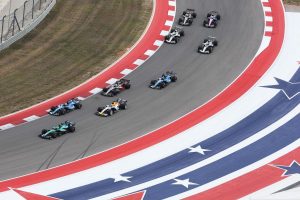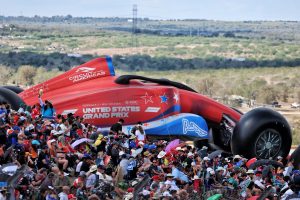
The United States Grand Prix didn’t end up producing the kind of four-car fight for Formula 1 victory that Friday and parts of Saturday hinted might happen, but that in itself told us plenty about teams’ and drivers’ strengths and weaknesses right now.
Here’s what we learned at Austin:
Red Bull needs a new clutch
Of all of the charges levied against Red Bull by Max Verstappen and Isack Hadjar after the US GP, it’s one from Hadjar’s dejected media appearances that seems most fundamental.
“The clutch. It needs a redesign because at the moment it’s too fragile, it’s not coping well with temperatures. It’s a real struggle.”
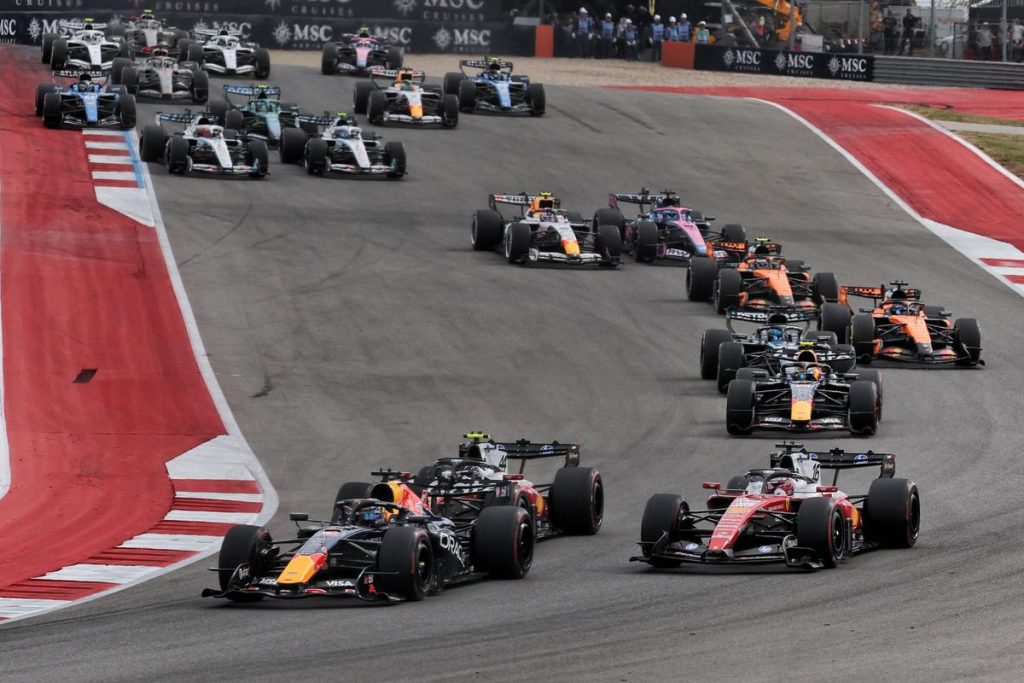
Hadjar was, he claimed, “spot on” in dropping the clutch but still it was “going into a nightmare” and overdelivering power, as he lost places to the two Ferraris on the run to the first corner.
He felt particularly frustrated by this because, in his eyes, it’s one of a number of “silly” problems (alongside repeat radio issues) that Red Bull keeps experiencing, having done the hard work of developing its way from slowest among the big four right up to the front of the pack.
And that progress is what team principal Laurent Mekies said is making these issues “even more painful now” because where once a poor start was costing it a sixth or a seventh in the end result, now it’s the possibility of getting a second car on the podium or even race wins.
But, as Mekies acknowledged, it’s also a complex, company-wide issue to solve that won’t be the work of a moment considering it involves the engine, gearbox, clutch and other components.
So while he’s confident Red Bull will make more progress before the end of 2026, “I equally know that we will not be the benchmark before the end of the season, that it will require some significant design and hardware changes, and that this is something that we will see only next year”. – Jack Cozens
Mercedes’ narrow window is bad news for Russell
George Russell’s self-declared “rubbish” race hogged the headlines – but while his Mercedes team has faith he can turn it around, the car shows no signs of helping him.
Russell’s on-off struggles with the 2026 rules have been well reported and go some way to explaining the deficit to his team-mate, Kimi Antonelli – who delivered one of his best performances of the season, according to team principal Toto Wolff, while Russell was stuck behind a McLaren for the majority of the race.
“George just struggled so much and I believe this is because the operational window of the car is so difficult,” Wolff explained.
The new upgrade has really, really not helped Russell in terms of extracting the most out of the 2026 Mercedes package. It’s narrowed the operating window significantly and that’s contributed to his struggles.
But Mercedes doesn’t sound as worried as Russell did after the race, giving him its full support.
“When it drops out of that operating window, he struggles, and he struggles more than maybe Kimi,” added Wolff.
“And that is on us. We just have to work it out with him how there can be such a difference in performance because George is not half a second slower, three tenths slower than Kimi. It’s just absolutely not the case.
“So what is it that he doesn’t like? What is it that we need to do in terms of modifying the car, setting it up in a different way for him to go fast? Because it’s all there – the intelligence, the ability, the determination.”
If Mercedes can’t broaden the window of its tricky upgrade, it looks like that will mean more pain for Russell, whose 2026 has slipped away in dramatic fashion. – Jack Benyon
Every Ferrari lap was good – except the two that counted
Ferrari’s US GP weekend was quite typical of its 2026 season: impressive in practice, underwhelming in qualifying, and then recovering quite well in the race – but not quite well enough to win.
As team principal Fred Vasseur said: “The weekend went well and everything is working well as expected on the package. The issue is that we did all the laps, from the first laps of FP1 to the last lap of the race, in good shape. Except the last two laps of Q3 on both cars, and it’s probably where we missed something.”
That stumbling in Q3 highlighted that Ferrari’s biggest issue is not necessarily its car/engine package – instead, it is executing things perfectly and nailing every aspect in what is an ultra-close fight at the front.
Lose a couple of tenths by getting those Q3 runs wrong and it’s the difference between a front-row start where you are chasing down the win and being dumped in the pack behind.
Some of the explanation for Ferrari’s qualifying difficulties comes from its car characteristics – in that, by having a chassis that looks after its tyres in the race, it can make it hard to fire the rubber up for qualifying.
But Lewis Hamilton also felt that the team needs to be better in hitting the ground running from practice with the perfect set-up, something it did not have in Austin.
Hamilton complained of the balance being adrift for most of the weekend, where he spent almost every session – and even every stop in the race – dialling more front wing in.
It was only in the final stint that things were in a place he was happy with.
“Through the pitstops, I added four clicks,” he said. “The next pitstop, added another four clicks, and even then I’m still another four clicks too short! It’s crazy to be 12 clicks down.
“We really need to look at how we are getting to that point because I think it would have been a bit different.” – Jon Noble
At-risk Bottas thinks driver comparison impossible
In the latest reminder that in F1 a multi-year driver deal can still end up being…not that, Cadillac is not yet committing to continuity with Valtteri Bottas into 2027 – with options like Colton Herta and Frederik Vesti circling around the seat.
Bottas approached the inevitable questions about this with a straight bat at the Circuit of the Americas, saying he “hasn’t seen or heard” any of the public bet-hedging from Cadillac and that “for now they seem happy with what they are getting out of me, so I think that’s all that matters”.
But in that assessment, Bottas hinted, the actual on-track metrics should be taking a back seat to other considerations.
He has been behind team-mate Sergio Perez in qualifying head-to-head this year, but not dreadfully so. The race pace comparison, though, is a lot more one-sided in Perez’s favour – and Bottas has had some true disasters, for one reason or another.
He insists, however, that it’s just not realistic to get a true picture given the sheer number of teething problems in Cadillac’s first year.
“I would say it’s impossible to get a read in a year like this with so many issues. And the problem is sometimes we don’t quite understand them,” said Bottas – who, fittingly for the point he was making, had retired from the US GP with an engine issue.
“It’s really still a steep learning curve to go. But at least everything seemed to work OK [until the retirement], and that’s why we had the same pace with Checo.
“But yeah, there’s been lots of things in the background that maybe not everyone sees, like the brake management, the amount of having to deal with that and all these things. At the same time, like I said, sometimes there’s been some issues that we are struggling to see.” – Val Khorounzhiy
Racing Bulls upgrade raised midfield bar even higher
Race by race, Racing Bulls just keeps ticking over towards this entity’s best-ever constructors’ championship finish.
‘Ticking over’ might not be a fair characterisation, though, as it’s now on a six-round run of scoring points and four in a row of beating main rival Alpine.
Granted, the Alpine – which had the better underlying pace at the previous three races – wasn’t at its best, but Racing Bulls also introduced another effective upgrade at Austin to cement its status and raise the bar for performance in the midfield.
That package included a new front wing endplate, new rear wing flaps, a reprofiled engine cover plus refinements across the floor edges, the leading edge and the bargeboards.
Chief technical officer Tim Goss said on Saturday evening that the car had “taken another step forwards in performance” as a result, and that Liam Lawson (who went on to finish ninth) and Arvid Lindblad “have made the most of exploiting this”.
“We have brought some significant aerodynamic updates to the car for this event, and once again our pipeline of upgrades and correlation to track has proved it is delivering,” said Goss.
Considering the mix of technical challenges COTA presents to the cars, Racing Bulls’ performance underlines how good a chassis Red Bull’s second team has built and successfully developed. – JC
Alonso’s furious at his F1 rivals
Fernando Alonso made no friends on Sunday at Austin, declaring: “I think the quality of the drivers in the lower third of the grid is very low, as we saw with Alex [Albon], so I think we need to improve the car and start a little bit higher up.”
That was prompted by Albon’s lap-one dive down the inside at Turn 11, where he made contact with Alonso, who was positioned just to the outside.
“I think we lost half a second or more [per lap], the car is destroyed; I saw it in parc ferme, half of the floor is not there,” said Alonso.
“I don’t know how we kept on going and how we were semi-competitive. I imagine if the car was in one piece, probably today the points were a possibility, a strong possibility because we were running P12 with half a car.”
He added: “We could have scored points today and maybe got close in the constructors’ championship, but they [Williams] made sure that we didn’t have any chance.”
Could 33% of the current F1 grid – which is regularly praised for its high level – really be considered “very low” quality?
Disrespectful, or a hard truth for F1 to contend with? Alonso’s given you his answer… – JB
Piastri still has a lot of work to do
Oscar Piastri had beaten team-mate Lando Norris in qualifying, but McLaren harboured precious few illusions as to who its quicker driver was this weekend. Hence a swift position swap in the race – floated in advance, team principal Andrea Stella revealed, in a pre-race discussion.
“It’s not been anywhere near as competitive as what I wanted it to be,” Piastri admitted of his performance during the weekend.
“I don’t think it’s quite the same picture as what it has been earlier in the season, but the end result is still the same.”
His race pace was, by his own description, “slow” and “just clearly not very good”.
“It seemed like a bit of a struggle in various different places,” he said. “I could kind of fix one place and not another.
“So I think it kind of just points to how tricky it is to get performance out of the car. I could achieve something decent one lap, but then trying to repeat it was very, very tough. So that’s been the story of the weekend and in some ways the story of the year.”
The bumpy COTA asked much of the McLaren drivers’ improvisational side, and as Stella admitted afterwards that is not Piastri’s “superpower”.
But it does need to be less of an Achilles’ heel. – VK