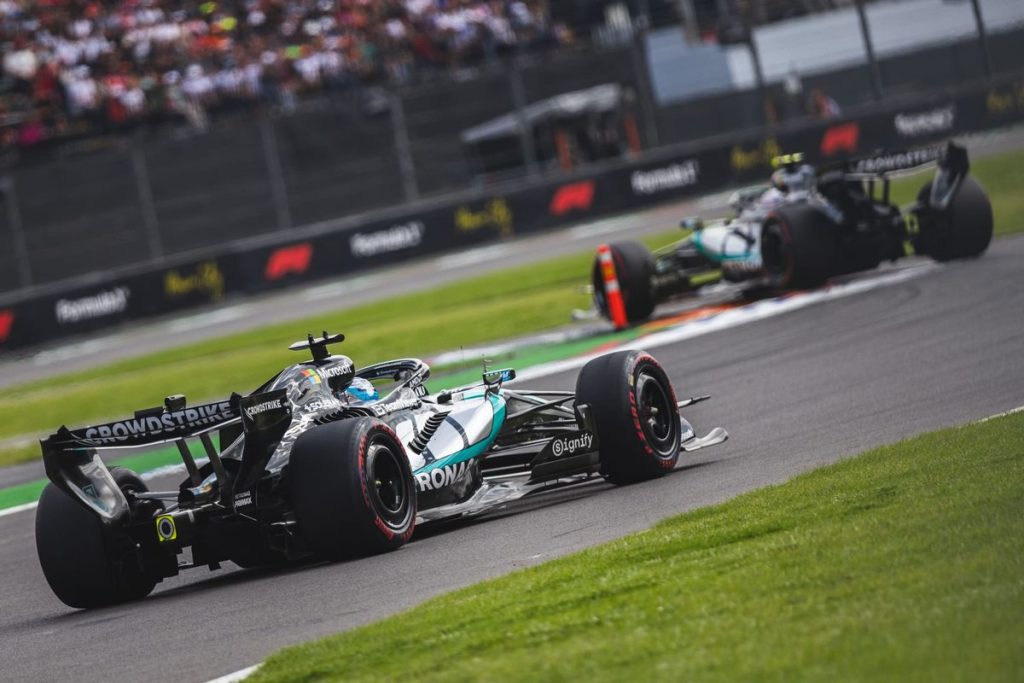
Kimi Antonelli’s historic Formula 1 title run is complete and so too is his crushing of team-mate George Russell in 2026’s major script-flip.
Having gone toe-to-toe with Lewis Hamilton in their three years as team-mates, and even ended with a clear edge over the seven-time world champion, Russell started 2026 by blitzing the season opener in Australia.
With Mercedes starting the new rules era with the advantage we all expected, it looked like the stars were aligning for him. Instead, just over seven months later, the title officially went to Antonelli four rounds early – and a distraught Russell still does not really know how.
As good as Russell’s peaks have been, the end result is embarrassing: beaten by a second-year driver eight years his junior. Antonelli’s won nine races to Russell’s three, is 130 points ahead, and has wrapped it all up four rounds early. These are not championship contender numbers from Russell, they are number two numbers, and he is the first to admit his performances have not been good enough.
But why not, and why have his high points been so infrequent? These have been the key questions asked by Russell himself, not just everybody watching.
If it was so easy to identify exactly what’s not working for Russell, he and Mercedes would have spotted it and fixed it. But analysing every session this year, dozens of laps and hundreds of data points, not to mention quizzing the two protagonists throughout the year, has enabled us to produce some key informed theories.
Sunday advantage dwarfs qualifying gap
First: qualifying. Russell’s previous reputation in F1 was Mr Saturday but Antonelli has definitively turned the tables here, even though his advantage is actually quite narrow in volume.
There are 109 sessions we have been able to compare across practice and each qualifying segment in 2026, and Antonelli is ahead in 58 of them compared to 51 for Russell. But practice sessions don’t mean as much as qualifying. And where it really matters, which is in Q3, or SQ3 on sprint weekends, the median average gap is just under two tenths of a second in Antonelli’s favour, standing at 0.185 seconds.
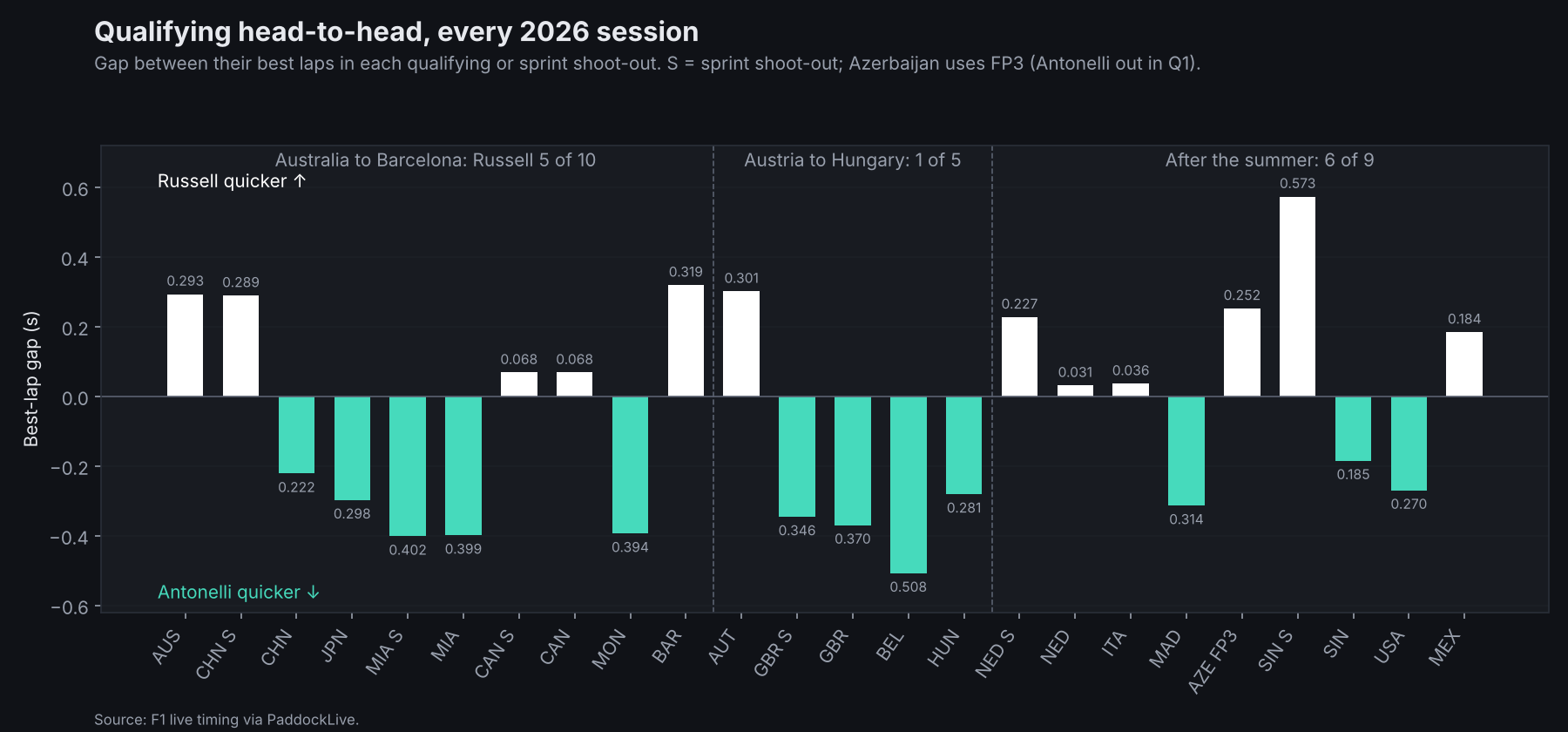
Qualifying is generally where Russell has been closest. He’s got five poles to Antonelli’s seven, for example, and Antonelli is only ahead 10-9 on grand prix starts. Russell’s been slightly better in sprint qualifying, too.
So here is where it starts to downturn. Because Russell’s prior ‘better on Saturday than Sunday’ reputation has unfortunately held – it’s just dropped from a lower peak, and Sundays have often been a one-sided contest.
The headline stats are already damning. Antonelli is winning 9-3 on victories, 16-8 on podiums, and has clinched the title early with that 130-point advantage over his team-mate. Evidently, he has been vastly superior in races. But the domination runs deeper.
Analysing both drivers in ‘clear air’, which we have set at a modest two-second gap to the car in front, and focusing on same tyre compounds and similar tyre life, Antonelli has been quicker in eight of the nine races where we can compare a meaningful run of laps, by around a quarter of a second a lap.
Baku, where Russell won from pole and Antonelli struggled more and spent a lot of the race in traffic recovering from his qualifying crash, is the only exception.
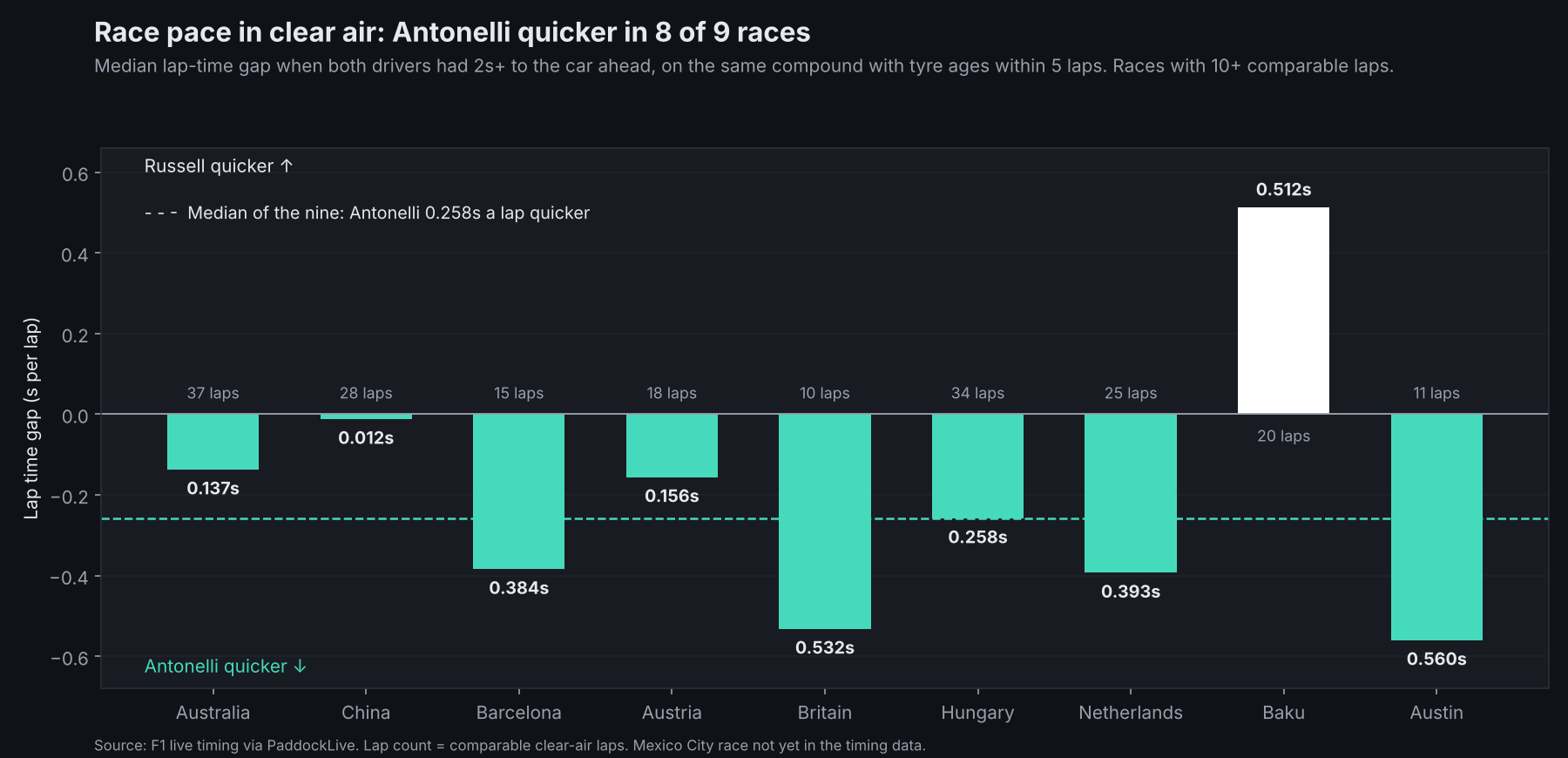
Antonelli often having a track position advantage will help. And it’s certainly hurting Russell’s cause to have had the lion’s share of engine performance issues this year – Mexico was an obvious example of Russell being screwed over, but at Silverstone and Spa he had other issues that Antonelli just wasn’t affected by.
Broadly, though, Antonelli seems to replicate his subtle speed advantage over Russell across whole stints. Even during Russell’s wins in Australia and Austria, Antonelli spent big chunks of the race lapping faster.
So let’s turn to the driving style differences that seem to be behind it.
Two contrasting styles
First, let’s focus on that difference between the two drivers. Russell often characterises it as him focusing on the mid-to-exit of a corner by getting on throttle as soon as possible.
“I’m quite aggressive on the throttle pedal, and I focus a lot [on] getting on the power early,” Russell says.
“And for him, it’s the opposite. He attacks the corners quite a lot, and he’s often on the power later.”
Across an assessment of every single Q3 lap between the drivers, it is indeed clear Antonelli tends to carry more speed into the corner and attack the corner earlier on, then trades off a bit on the exit.
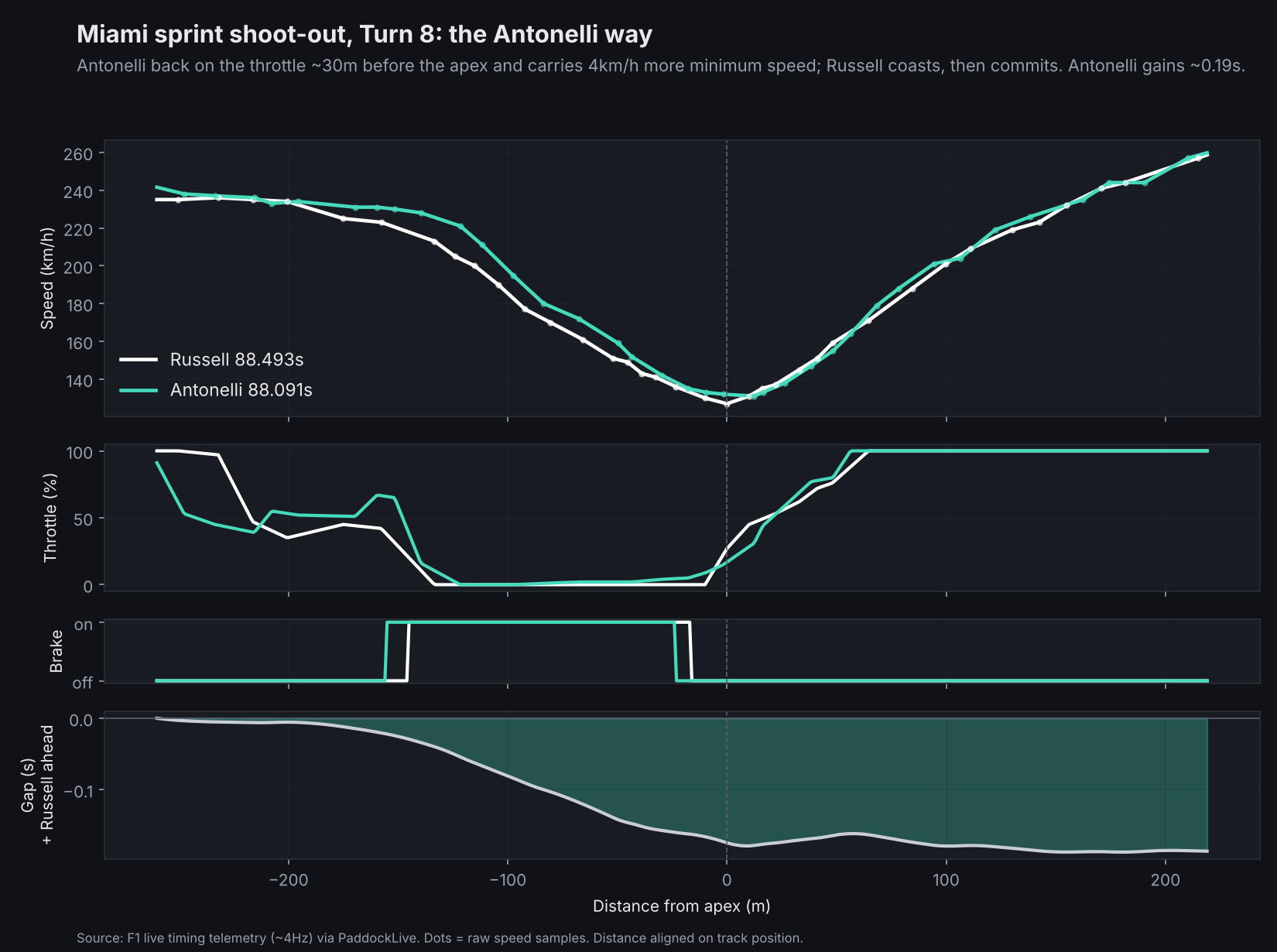
But quite often, in all types of corner (slow, medium and fast) Antonelli picks the throttle up earlier than Russell, just more gently – especially so in quicker turns. Russell waits through the corner, then commits harder, and applies more throttle mid-corner particularly off slower turns.
The contrasting styles mean Antonelli carries more speed from turn-in to the apex. He often brakes a little later but either a little less or more likely holds the pedal a little more into the corner at the end of a braking zone (commonly referred to as trail braking) to settle the car while carrying more speed.
A sharper steering input compared to Russell’s smoother, later approach helps Antonelli rotate the car efficiently and then get back on the power quickly enough that he tends not to lose out as much as you might normally expect given how much extra speed he’s carrying in.
What’s interesting about that is the 2026 cars move around a lot more and don’t have the same grip as before. Antonelli seems able to thrive with any instability or sliding, and maybe even controls it slightly better with the way that he’s using the brakes and dancing on the throttle.
He seems to be much more proactive in that crucial middle phase of the corner, whereas Russell, coasting more, is just waiting to be able to emphatically complete his rotation and definitively get back on full throttle again. Turn 8 in Miami qualifying offers a good example of this.
Russell’s typically been as good or quicker than Antonelli through slow, shorter corners, probably because there’s less of that coasting phase. Think of tight, slow corners such as Turn 3 in Melbourne, the hairpin in China, Turn 3 in Austria, or most of Baku – these seem to be a little bit more aligned with how Russell likes to drive.
Even Barcelona, where Russell took pole, he was particularly strong off the Turn 10 hairpin there compared to Antonelli after trading a bit more on the way in.
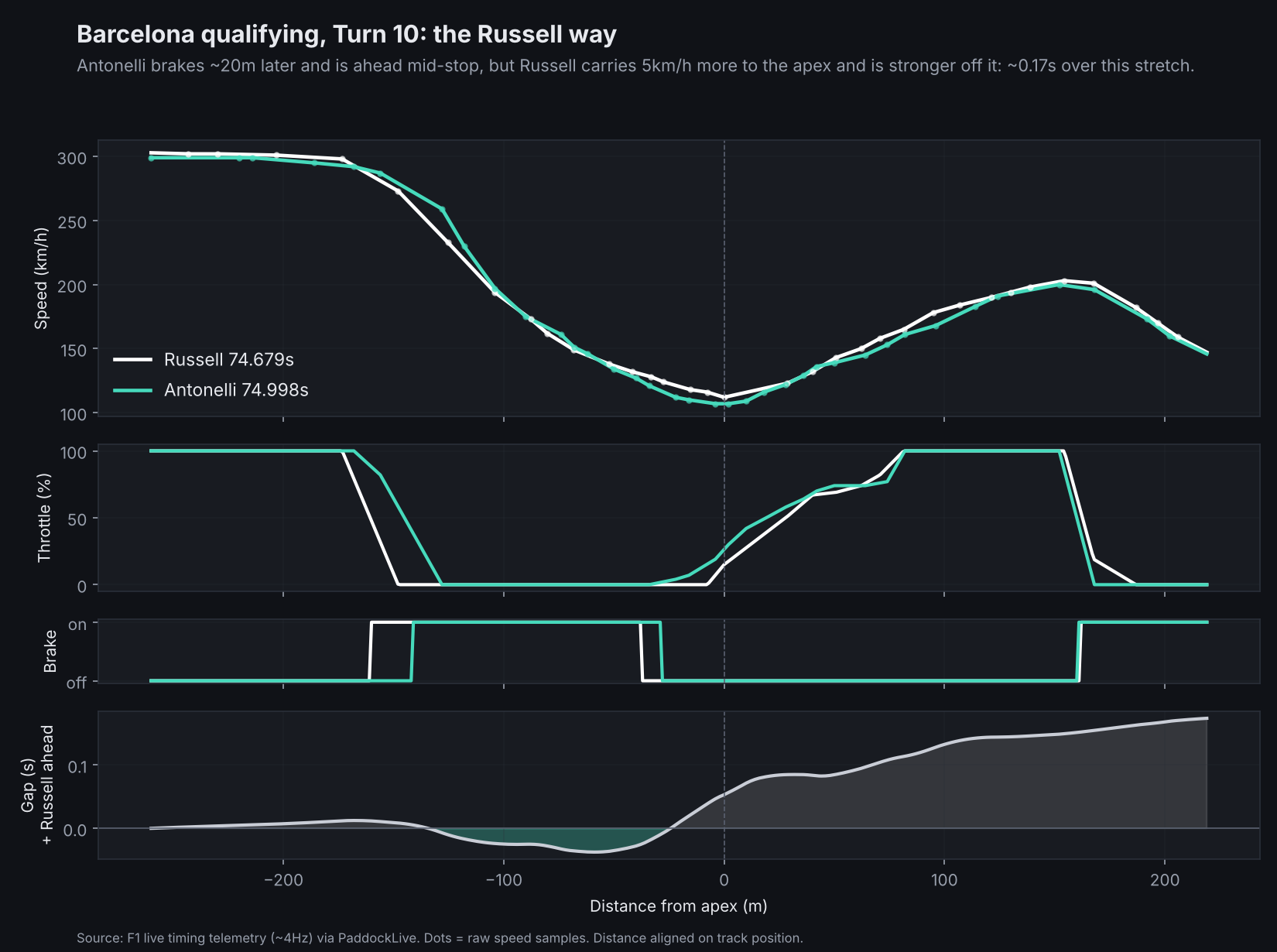
But where there are sequences of corners, or corners with longer entries, Antonelli seems to roll a bit more speed into and through them. In comparing his 11 faster qualifying laps this year, we found Antonelli ‘won’ the turn-in to apex phase of the corner 71% of the time, typically worth a few hundredths of a second net gain even once the loss on exit is factored in.
It’s worth emphasising first that these are typically minor differences between them in qualifying, but they sometimes add up to quite a lot. Antonelli has six qualifying wins by 0.35 seconds or more, with Russell having just one by that margin.
That could signal a snowball effect of confidence in the car, perhaps with certain track layouts playing into it a little bit more, or some weekends where the Mercedes car characteristics might favour one driving style over another.
On other weekends, the engine’s sensitive energy management demands in 2026 are a factor too.
In Austin, for example, Antonelli taking more speed into the medium-speed sweeps in the first sector meant he used less throttle in the middle of those turns, whereas Russell’s approach meant he picked the throttle up more. This seemed to mean a bit more battery deployment versus Antonelli down the short subsequent straight, which gained Russell less than it subsequently cost him with slightly less energy to use on the longest straight after.
We do not have access to Mercedes’ very detailed battery information to be able to state conclusively this was a regular, significant difference over the season, but it was at least not an isolated incident. There has been a lot of talk about Antonelli’s style matching the engines and being more efficient, with Russell adamant that this is a factor.
Antonelli has also been extremely good at managing rear tyre slip this year, moving the car around enough to get through the corners quickly but not overstressing the rears especially.
Russell, meanwhile, has had laps where the pace just bleeds away because he hasn’t kept the rear tyres under control. And in races, in nine of the 14 stints where we can match them up directly, Russell’s laptimes have dropped off faster with tyre age.
The way the tyre pressures are generally higher this year has typically made the car more rear-limited and punished drivers trying to be more aggressive on throttle – either in how they use this to help the car’s final rotation or simply in trying to deliver the power less progressively.
“That has hindered me a little bit by pushing the exits,” Russell reckons. “The rear tyre can’t cope with it as well.”
This comes at a cost of traction off the corner but also potentially efficiency if there is some throttle modulation going on to correct a slide. Either way, a more controlled exit gives a subtle advantage over a single qualifying lap and in a race stint it’s really valuable.
But maybe we should not be entirely surprised by this. Yes, Antonelli is a second-year driver, so his experience with the tyres is very different to Russell’s, but the tyre challenge is significantly different this year, which offered a reset.
And Antonelli’s race engineer is Peter Bonnington, who spent years with F1’s tyre whisperer-in-chief, Lewis Hamilton. If any of that has rubbed off, it’s exactly the skill this year’s tyres reward.
Transformed from his first 2026 lap
Clearly, Antonelli’s soaked up a lot of feedback and maximised how the driving requirements have changed due to the tyres, the car and the engine. But the scope of the change has been remarkable.
Even Mercedes team principal Toto Wolff has admitted surprise at what Antonelli has done this year, in only his second year in F1, and at just 20 years of age.
There was no indication last year, even amongst Antonelli’s occasional peaks, that he was capable of such a big step. Russell outqualified him at 15 circuits in 2025 – in 2026, he’s only done so at seven of those same circuits.
The driving style difference itself isn’t new. It was there in 2025 too, it just played into Russell’s hands more last year. If anything, it’s become more pronounced this year – Antonelli emboldened to start picking up the throttle a few metres earlier than before.
This ruleset does just fit Antonelli very well. It was obvious to him it was going to be a very different season even from the very first laps he ran in the wet at Mercedes’ shakedown at Silverstone.
Last year’s Mercedes didn’t really facilitate how he likes to agitate the front axle and his way of being very busy behind the steering wheel, attacking corner entries and managing the rotation through the corner early. There was so much downforce from the ground-effect aerodynamics that it masked the actual feeling from the car itself. When the grip went, it went in a big way and you couldn’t catch the car.
This sapped Antonelli’s confidence, which was already fragile going into the season off the back of that infamous FP1 crash at Monza in 2024 on his practice session debut. As Mercedes had its own ups and downs in 2025, Antonelli got lost too much, too often and was just quite badly constrained.
In 2026, Antonelli has a car that, while unpopular with many drivers, has less aero and mechanical grip and so can be manipulated more and for him it actually allows a bit more feeling.
Antonelli was immediately less tense driving the 2026 car back at that shakedown. Antonelli says he can feel, and almost predict, the limit more. “I’m more in control of the situation,” as he puts it.
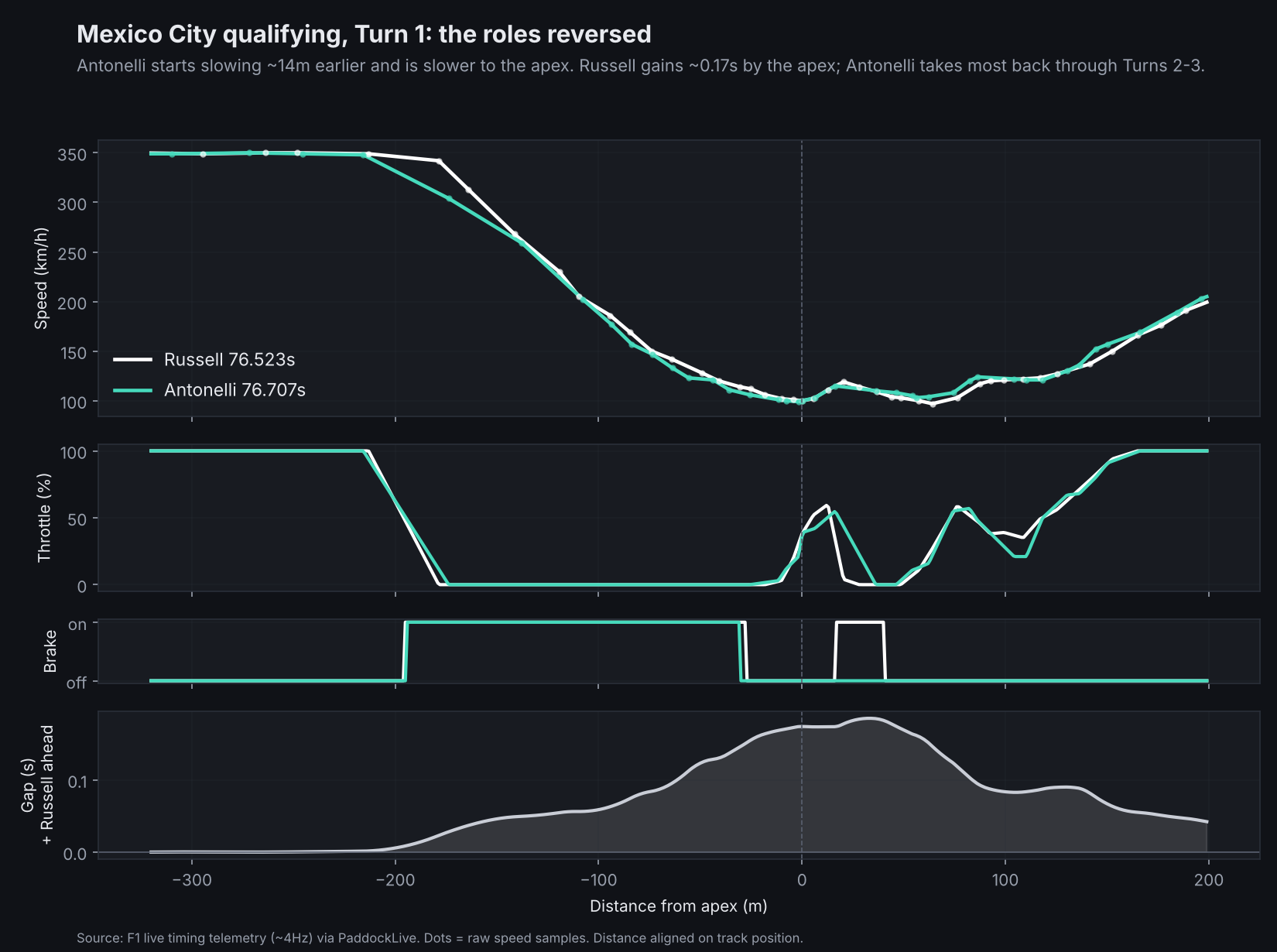
If Antonelli is not confident in himself or the car, and doesn’t have the feeling to judge what the rear is doing and how the car’s reacting to his inputs, his inputs won’t be as aggressive as they need to be. This was actually evident in Mexico where illness and the prospect of clinching the title, Antonelli reckoned, meant he “didn’t have the same intensity” as normal – and all his usual strengths versus Russell over the year were reversed in qualifying there.
Russell has tried to move towards Antonelli’s way of driving but doing so has been less natural. And the story of his season has not really changed: when it works he’s as fast as or faster than Antonelli, other times he falls further away. He also seems more sensitive on those weekends where Mercedes doesn’t really have its car figured out – Russell can sometimes drag a good lap out of the car in qualifying, then cannot replicate it over stints.
Like Russell said in Mexico: he just doesn’t have average laps or average performances this season. He’s either really good or off it, while Antonelli has maintained such a high, consistent standard.
It leaves a lingering degree of confusion over exactly why it’s only worked for Russell some of the time, and that also complicates how he works to get on top of it for next year.
The cars are losing downforce, which will change how they behave aerodynamically; the engines are changing so the sensitivity to energy deployment won’t be quite as extreme; and the tyres will become more front-limited, which is something Russell really feels could move things back in his favour.
Hoping it will help isn’t enough, though. Russell has a big winter coming up to figure out his own limitations after being emphatically outshone, outdone, and outclassed by Antonelli in 2026.