While the ghosts of Abu Dhabi 2021 may never vanish totally, errors made that day exposed how the FIA needed to run Formula 1 races better.
Too much pressure placed on single individuals, a lack of support for race control on site, not advanced enough systems and the ever-expanding demands on staff meant change was not just desirable but essential.
Arriving amid the fallout of that controversial title decider, FIA president Mohammed Ben Sulayem promised direct action, and one of the first things he greenlit was a Remote Operations Centre (ROC) to offer more support, advice and back-up.
The FIA set up its first ROC in Geneva in early 2022, but it was quite a basic affair. This week ROC 3.0 was officially launched – with Ben Sulayem and F1 CEO Stefano Domenicali in attendance.
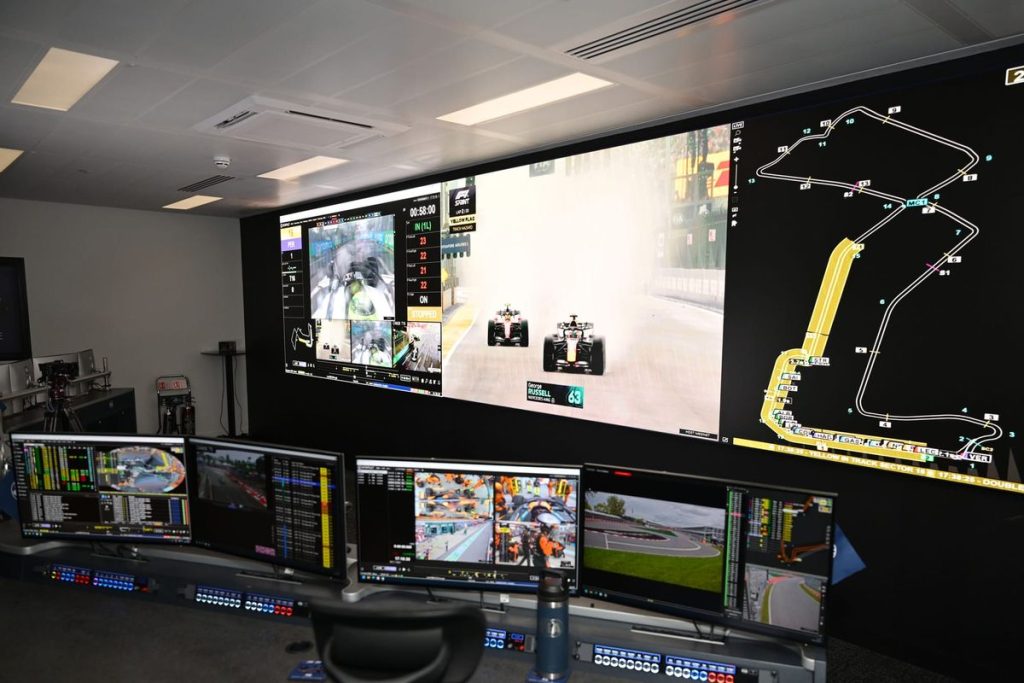
Now in a bespoke room at F1’s Biggin Hill headquarters, filled with desks that are manned by around 14 analysts on race weekends, it has been working away since the summer break.
What does ROC do?
As a joint initiative of the FIA and FOM, ROC is one of four key components for the smooth running of grands prix – working alongside race control, systems operations, and the stewards.
It covers a lot of ground – such as whether cars are in or out for track limit offences, judging potential yellow flag infringements, checking if cars are in their grid slots at the start, and monitoring incidents to help race control better evaluate if safety car or red flag responses are needed.
Feeding into ROC is live data from the track, including more than 140 audio and video feeds, car positioning telemetry and radio communications. Advanced technology is also used, including AI-assisted shape recognition, computer vision and automatic radio message tagging to help flag on-track incidents.
One of ROC’s core benefits is that technology and human interaction can be used to take tasks away from a race control that has its hands full at the track.
How track limits are judged is a perfect example. A three-layer automated system is used to work things out – comprising computer vision, racing-line deviation and geofencing.
AI will pre-filter roughly 90% of track limit breaches because they are so obvious, so a human only needs to assess in detail the 10% that are marginal.
This minimises time-wasting and ensures that proper diligence is done on the borderline ones that matter.
ROC’s role is not to be judge, jury and executioner in deciding on track limits penalties; it is to provide all the information so the stewards can make the calls themselves.
Tim Malyon, the FIA’s sporting director, said: “Ultimately it’s the stewards that delete a lap – so they will then review just to make sure that they’re happy.
“Obviously in some cases it’s a quick decision. In other cases where it’s a bit more borderline, it takes a bit longer.”
There is another critical layer where ROC has an important role to play, and that is transparency of the decision-making processes.
So once a call has been made to delete a laptime, the relevant evidence is sent immediately to teams to show them why.
Malyon adds: “One of the reasons I think we’ve been reasonably successful at completely removing track limits as a talking point is that we deployed the technology, shared the technology, and distributed the evidence freely to all the teams.”
But it is not just on regulatory matters where ROC has a role. It also supports race control on some safety matters, too.
One learning from George Russell’s penultimate lap crash in the 2024 Australian Grand Prix was that race control needed better information about the status of a car and driver once a crash has happened.
So now there is a bespoke desk that can help pull up all the relevant onboards and information to help race control work out what sort of intervention is needed.
Malyon added: “We realised at that time we needed a much quicker way to identify a car that had an issue, and provide all the information about that one car to be able to make an assessment of where it was – was it in a safe position? was it in an unsafe position? – and to allow us to progress as quickly as possible to a neutralisation if needed.”
A rapid evolution
The transformation of ROC since 2022 has been immense, as Malyon says where it is now is a world away from how it started. But equally, time was essential to actually understand what was needed.
“ROC 1.0 in its first inception was four people, sometimes one or two more,” he said. “Actually, as a facility, I was quite pleased at the time. It came together very quickly.
“We were able to repurpose a former race control desk – but it was ultimately a converted meeting room with a race control desk and a much smaller video wall.
“When we first started, obviously we had to understand the technology, but we also had to understand the relationships and the responsibilities, and it was something that grew quite organically. We were lucky enough to have a few key people in there that had experience of similar facilities that they’d used in teams or similar.
“As a result, I would say over the first six months there was a very, very significant ramp-up and a building of trust.
“I think that was key to the success, really, building that trust between race control and the ROC and understanding the right way to work together to be an effective force multiplier, not just another voice.
“And sometimes, as you’ll know, a single voice making clear decisions is obviously very important when it comes to time pressure.”
Ultimately, technology can never replace humans when it comes to enforcing regulatory aspects – but what ROC intends to do is reduce the risk of mistakes being made.
As Ben Sulayem said: “Minimising the human error is very important – but getting rid of the human factor, it’s impossible.”
Better information fuels better decisions, but ROC’s value comes also in making sure that race control and the race director can focus on critical areas and are not overwhelmed by having to do things that can be handled elsewhere.
The Abu Dhabi 2021 inquiry concluded that too much stress being placed on individuals’ shoulders only increased the danger of errors being made.
Had ROC 3.0 been around in 2021, then that year’s Abu Dhabi Grand Prix may not have turned into what it was.
But as Ben Sulayem says, time cannot be rolled back, and the important thing was that every effort was made to ensure the same mistakes were not repeated in the future.
“This promise was done,” he said. “What happened in Abu Dhabi in 2021 could have been avoided. But we can’t go to the past. We have to go to the future.”