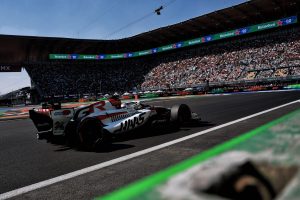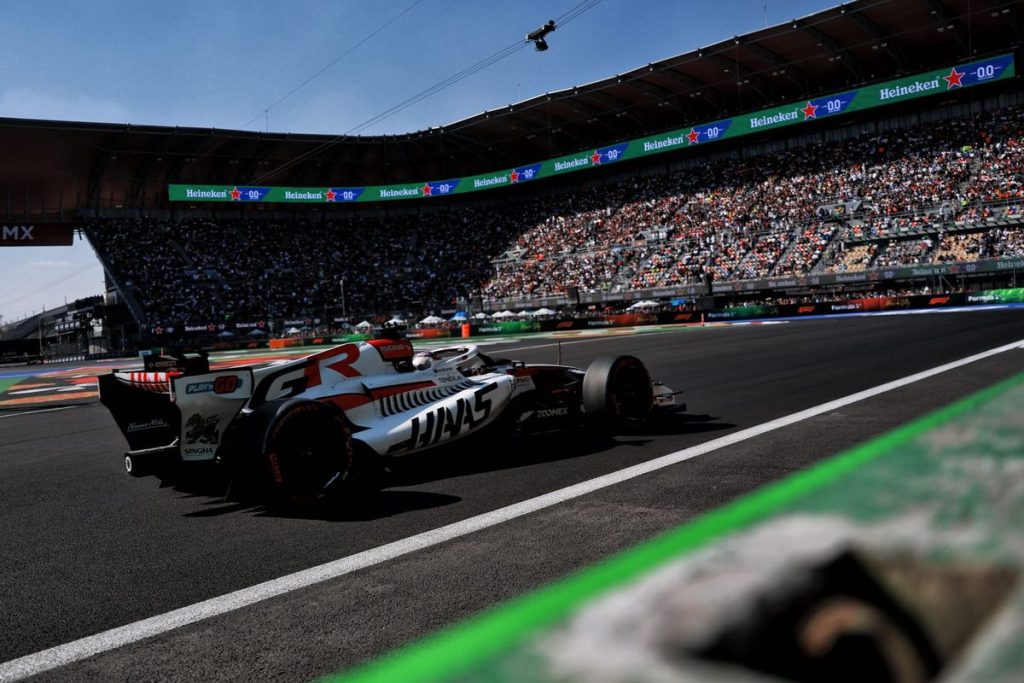
Ryo Hirakawa was about to go for his usual run on Saturday morning in Mexico when he got the call telling him he would get the opportunity “I’ve always been ready for” to qualify for his Formula 1 debut.
Despite the short notice, Haas’s shock Esteban Ocon replacement was disappointed not to reach Q2 in 19th place given his final qualifying run was compromised by traffic.
The 32-year-old long-time Toyota driver, a Le Mans 24 Hours winner and two-time World Endurance champion, received unusually late notice that he would take over Ocon’s car for the remainder of the weekend.
Hirakawa wasn’t driving it cold having run in FP1, his ninth outing since late-2024 in F1 sessions, and having also logged a combined total of 4541km (2822 miles) in the 2023 and ’25 Haas cars over the past two years. But even so he was in at the deep end.
FP3 was inevitably a compressed, intensive session in which no driver logged more laps than he did. The work was efficient, with clear communication to and from race engineer Laura Mueller as they crammed in a mini-long run, practice starts, qualifying simulations and took multiple opportunities to refine how he attacks the pit box. That included one practice pitstop without a tyre change that let him also hone the release. It meant he went into qualifying relatively confident, even if he recognised there was plenty he needed to tidy up.
Both Haas drivers completed three runs in Q1, with Hirakawa 0.330 seconds slower than team regular Ollie Bearman on the first lap – a deliberately neat and tidy banker effort – then 0.304s slower on the second as both made a similar step. The main deficit was in the final sector comprising the stadium section and last corner where, as Hirakawa pointed out, “as soon as you slide you [pay] the price]”.
Hirakawa failed to improve on his final attempt and ended up 0.875s down in 19th while his team-mate advanced to Q2. However, that was not down to him not having the edge when it came to extracting the peak of grip at the end of the session.
He improved on his personal best time in sectors one and three, but had Alex Albon ahead in the middle sector. Albon wasn’t directly impeding him, but he created costly aerodynamic turbulence and left Hirakawa disappointed. The time loss started with a little given away through Turn 4-6 at the start of the second sector, which he started 4.5s behind Albon, and got worse in the esses.
“I had traffic from Turn 6 and also [in the] high-speed sections, so I lost a lot of downforce,” said Hirakawa. “It was, I would say, easy to [reach] Q2, which is a shame for me, but still it’s nice to be here, so I can’t complain much.”
So does his claim stand up? We at least have sectors one and three to use as definitive proof of his pace so those stand – and the dotted delta line in the chart below shows just how much of the deficit came from that middle sector (from just before Turn 4, to just before Turn 12).
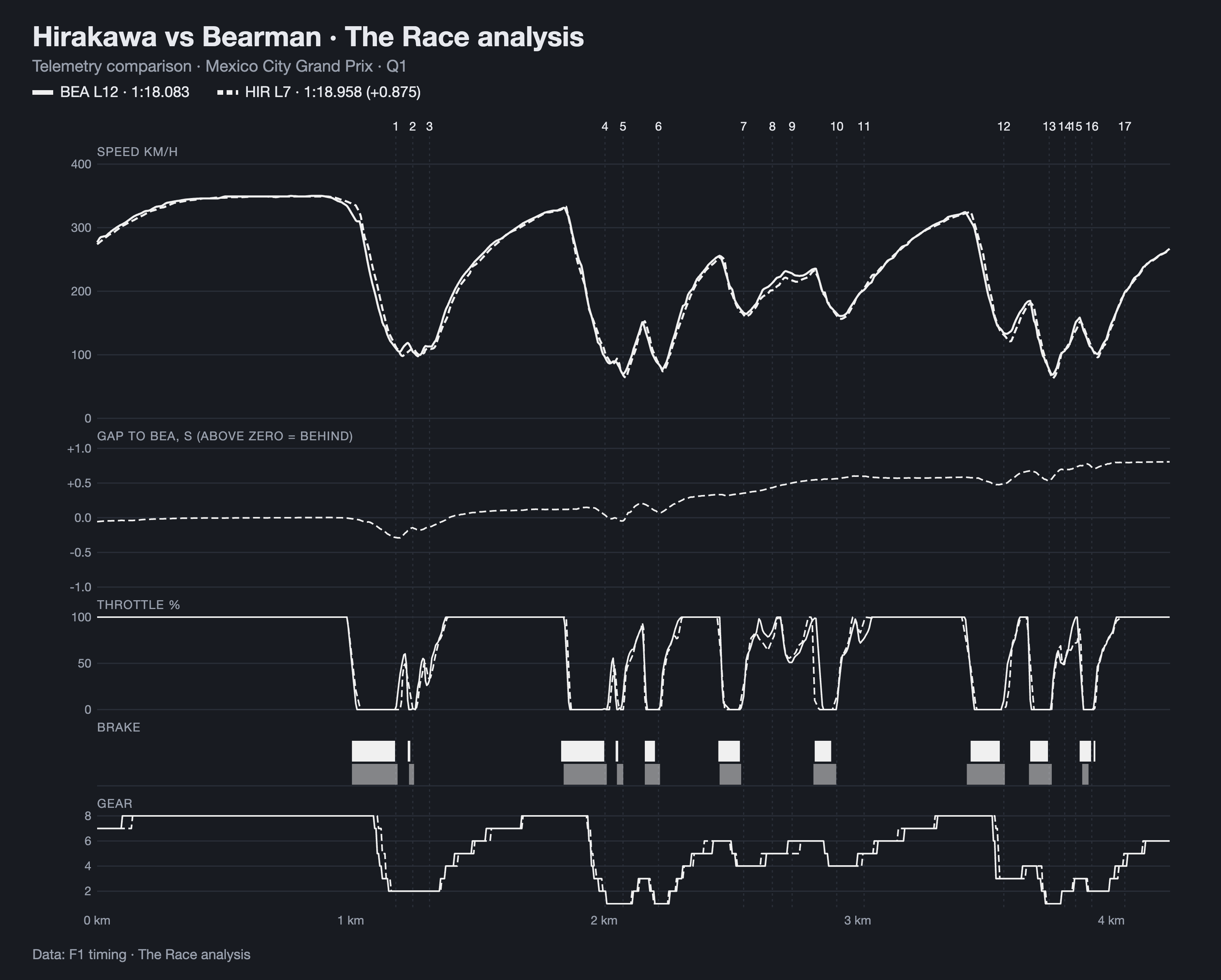
Given Hirakawa had followed Bearman between runs one and two, it’s reasonable to assume he might have made the same step as his team-mate in the middle sector relative to his previous run as track conditions improved and he better honed his driving.
That gives Hirakawa a hypothetical middle sector 0.537s quicker than the one he did on the last lap, which would have put him up to 15th place, ahead of Alpine’s Franco Colapinto and eliminating Carlos Sainz instead of him – albeit only by 0.066s. He would have been 0.372s slower than Bearman on this lap-that-never-was, which is also in line with the pace deficit on the first two runs.
It is not definitive proof that he would have reached Q2, but it at least proves that his claim he could have advanced is reasonable. Team principal Ayao Komatsu drew a similar conclusion.
“Ryo was drafted into the car last minute, and I think considering that, he’s done a really good job,” said Komatsu. “In FP3, the progress he was making was very clear, and Q1 is always a very tricky session with the tire being on the edge, but he stayed calm and managed to extract most of the performance.
“It’s a shame that he had traffic in the worst possible place, in the high-speed corners. I don’t know if he could’ve made it to Q2, but it would’ve been close. That would’ve been his reward for his great effort today.”
To have had a realistic chance of reaching Q2 represents a job well done for Hirakawa, but a more complicated challenge awaits in the race.
Asked by The Race what a good Sunday would look like, he kept it simple: “good start, good first corner, a lot of new things, so just execute and do my best.”