Former Editor of Inside Kung Fu, screenplay writer and producer Paul Maslak remembers his old friend with this written tribute. Remembering James Lew.
In Hollywood circles, they often say that the villains make the movie as much as, and
sometimes more than, the heroes. James Lew understood that dictum of drama as well
as any actor I’ve worked with.
Fortunately for those of us who knew him, he always left the villainy on the set.
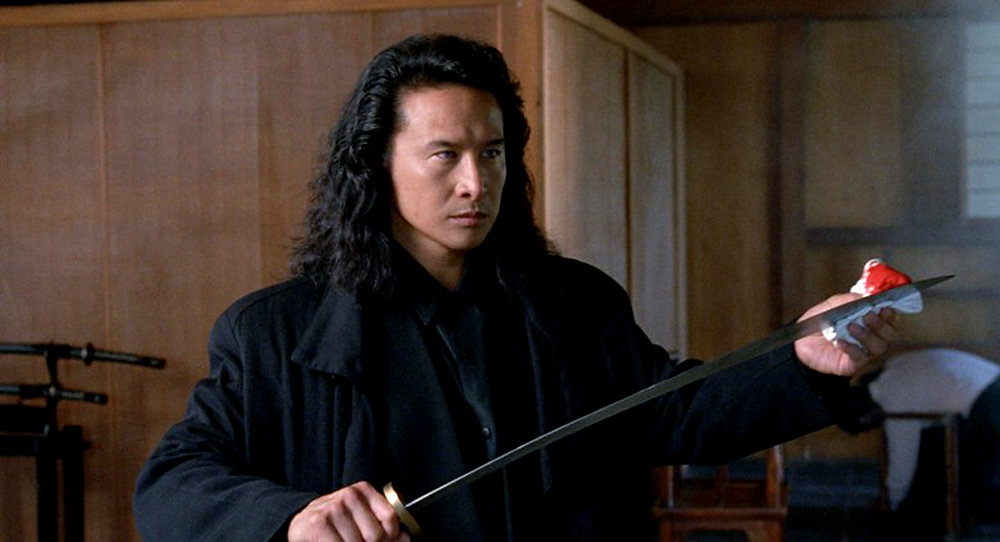
I had the privilege of casting James in his first starring role, as ‘Jaho,’ the death-touch master in the HBO actioner “Red Sun Rising.” It became HBO’s highest Nielsen-rated world-premiere movie that year (10.3 rating, 15 share), in no small measure because of James’s inspired performance.
I remember James Lew as a good-hearted and remarkably unpretentious man, with a quick wit, a male model’s good looks, and brilliant martial arts skills. Whenever he was near, you felt his cheerful warmth, infectious positivity, and steadfast friendship.
I also remember James as one of those people who was always willing to step up. If
something needed doing and James could do it, he did it with good humor, without complaint, and usually with that smile of his. Looking back now, I realize how many of my memories of him begin exactly that way.
My history with James goes back much further than “Red Sun Rising.” I worked with
him while I was editor of INSIDE KUNG-FU magazine. Our offices were then on the site
of today’s In-N-Out Burger, the one celebrities famously descend upon after the Oscars.
Anyway, one day, Jackie Chan unexpectedly showed up for what would become his
very first interview in America.
Naturally, none of the editors were there.
That included me, which, as a martial arts editor, was not my finest hour.
Hey, I didn’t know he’d come by that day. They were in Hollywood; I was in San
But James happened to be around.
Now, James was many things: a superb martial artist, a stuntman, an aspiring actor,
a remarkably good-looking human being, and a kind soul. What he was not, under even
the most generous interpretation of the First Amendment, was a journalist.
But he was there. We were not.
Jackie had brought along a Cantonese interpreter. Our publisher, Curtis Wong,
pointed James toward Jackie Chan and, trusting that the chi would be with them, left
James did what James always did.
The interpreter persevered.
The interview, though, showed less determination.
Let’s just say journalism took the day off.
Then, weeks later, I asked James to step in as the fall guy for a Jackie Chan “techniques” magazine photo feature. James was the only guy handy whom I knew could keep up with the now-legendary Chinese opera star turned movie star.
James would later work on all three of Jackie’s “Rush Hour” films.
Fast-forward a few years. As a personal favor, I again got James to step in, this time
as a stunt double to perform a daring aerial cartwheel kick over a hard-slashing sword
for the climax of “Ring of Fire.”
Not a feat that even the best martial artists could pull off.
We were filmmakers. One good take always deserved another. A few years later, my business partner Neva Friedenn and I were heading up our
first production as keyman producers, “Red Sun Rising,” starring Don “the Dragon” Wilson, Terry Farrell, Michael Ironside, Mako, Edward Albert, Stony Jackson and, ultimately, James Lew.
The story grew out of an idea that came to me while I was editor of INSIDE KUNG-
FU. I thought the ninja movies of the day had it all wrong. A modern ninja wouldn’t be
running around in 16th-century pajamas wielding primarily 16th-century weapons. The Japanese samurai, the traditional nemesis of the ninja, had largely evolved into policemen. So, I reasoned, maybe the ninja evolved into yakuza assassins.
We also gave our modern ninja the infamous Chinese dim mak death touch.
Okay, we were not letting cultural consistency get in the way of a good villain.
But voilà: Don “the Dragon” Wilson versus James “the Dragonmaster” Lew.
I knew almost instantly that I wanted James for the role.
Hollywood sometimes takes the scenic route.
Even a keyman producer has to gather collaborative support.
Our savvy executive producer, Ashok Amritraj, insisted that we go after Jet Li first,
which we did. I’d seen Li perform live as a child headliner for the Wushu Troope of the
People’s Republic of China at the Kennedy Center in Washington, DC, as well as in his
Chinese hit movie “Shaolin Temple.” But he was already signed to make his American
debut in a “Lethal Weapon” sequel.
Then Ashok insisted that we try Bolo Yeung. Not a bad idea. An “Enter the Dragon” villain. Again, he wasn’t available.
Finally, Ashok gave us the go-ahead to open up the casting.
Neva and I already knew who we wanted. Don “the Dragon” totally concurred.
Our last obstacle was convincing our BBC-veteran movie director, Francis Megahy.
He needed to see an acting audition, and not just from one candidate.
James was spot-on brilliant in his reading.
Regardless of our behind-the-scenes nudging, James flat out won that role the old-fashioned way: He earned it.
Actors sometimes use the mental image of an animal to help build a persona for their character. James chose a shark for Jaho. His elegant acting coach to the stars, Ivana Chubbuck, suggested purple contact lenses to help bring that image to life.
A shark with purple eyes.
James graced us with a memorable performance. Certainly, my favorite villain
among all the cable-TV movies I produced.
His epic showdown with Don “the Dragon,” staged beneath the downtown Los Angeles skyscrapers against the night sky, seemed to leap from the screen. Fight master Art Camacho joined the duo in choreographing something cinematically special.
Many years later, in 2017, I reached out to congratulate James on winning an Emmy
as stunt coordinator for Marvel’s “Luke Cage” on Netflix.
Then James reached out to me when my producing partner, Neva Friedenn, passed
And in 2024, James received another richly deserved honor when BLACK BELT
magazine inducted him into its Hall of Fame as a recipient of the Martial Arts Stunt
Performer Award, alongside fellow Hollywood martial arts veterans Jeff Imada and
It was nice to see this good guy finally get some glory.
And now, on August 23, James passed.
It is hard for me to reconcile the James I remember, the man who could fly sideways
like a buzz saw over a slashing sword, take after take, with the physical frailty that overtook him toward the end. Time is not gentle even with the strongest among us. But what it could not diminish was the affection James had earned from the people whose lives he touched.
I’m told that, at the end, James was surrounded by family and friends who loved him.
Somehow, that seems fitting.
James spent a lifetime showing up for others.
And when his time came, people who loved him showed up for him.
I’ll remember the quick wit, the cheerful warmth, the remarkable talent, and the friend who, whenever something needed doing, always seemed willing to step up and say yes.
James Lew was a good man and a good friend.