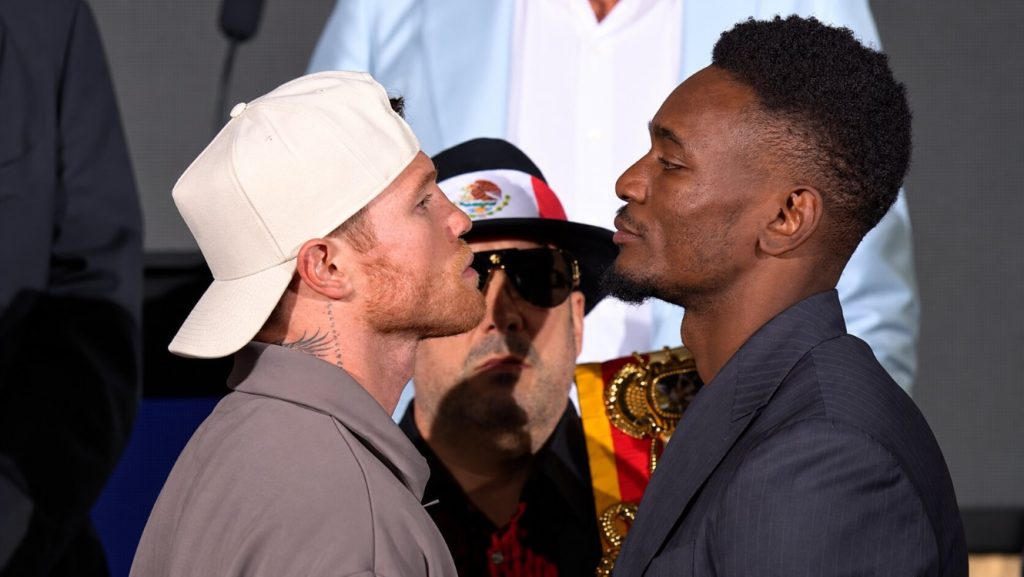
Canelo Alvarez looks to have picked the softer option in Christian Mbilli, though nobody expects an easy night at the office. Mbilli gives Canelo clear lanes to time counters, letting him steal rounds on the scorecards even if he gets outworked. Osleys Iglesias, on the other hand, represents a far more unforgiving matchup.
Promoter Richard Schaefer repeatedly praised Canelo at Thursday’s final press conference for picking Mbilli to give fans the best fight possible. That narrative ignored how slim the pool really was. With WBA titlist Jaime Munguia practically off the table due to gym loyalty, plus a vacant WBO belt, Canelo really only had Mbilli or IBF champion Iglesias to consider.
“Because I do not believe in shortcuts. I have been a champion for many years. I just want to fight the best,” Canelo said when asked about the decision.
Even if Mbilli throws a hundred punches a round, Canelo knows how judges score fights. A crisp, explosive counter shot that snaps an opponent’s head back often wins rounds over flurry work that lands to the body, head, or gloves. Against Mbilli, Canelo has a clear path to win rounds on the cards.
Iglesias is an entirely different problem, and arguably a far more punishing one. The Cuban is a rangy, hard-hitting southpaw who controls real estate with a stiff jab and detonates with a lead right hook. Canelo struggling against disciplined boxers with length and movement is well established.
Following Iglesias around the ring while absorbing straight lefts, right hooks and jabs would be grueling, with very few clean openings to fire back. Iglesias brings real knockout danger without needing to smother himself on the inside to get it. Iglesias brings the bigger punch, but he also possesses the technical skill to dominate without hunting for a knockout.
Canelo risks trailing, missing, and soaking up damage without landing enough in return to keep pace. Reaching the final bell would still leave him battered. That is a projection, yet the Cuban’s length, precision, and power make it a very real danger.
Mbilli brings heat of his own. His swarm could pin Canelo against the ropes for long stretches. The difference is that Mbilli’s relentless forward motion keeps him squarely in range for Canelo’s signature counter rights and body hooks.
That gives Canelo a realistic path to victory. Mbilli can throw and land three as many punches, but judges often reward Canelo’s cleaner, harder single shots. Activity does not guarantee points, and Mbilli will offer plenty of targets for flashier work.
Canelo would get far fewer looks against Iglesias. He would need to evade the jab, close the gap, and connect before Iglesias moves away or fires back with something harder.
“I just need to be myself, and that is how I am going to win this fight,” Mbilli stated.
He could be right. Mbilli’s furious engine could easily overwhelm the veteran if Canelo cannot punch with enough authority to slow him down. Calling him the better option is far from guaranteeing a Canelo win.
Canelo never admitted to dodging Iglesias over stylistic concerns, and this remains a personal breakdown of the matchup. Still, Schaefer’s spin invites a reality check. Between the two champions on the table, Canelo selected the opponent who gives him room to land and a much clearer route to a victory on the cards.
It still could be controversial if Canelo wins a decision against Mbilli, but at least he would see the final bell, and his face wouldn’t likely be as beat up as it would be against Iglesias.