Courtesy of Anti Wave, a SwimSwam partner.
Modern aquatic facilities must accommodate a demanding mix of uses. The same pool may host early-morning lap swimming, school lessons, high-performance training, water polo and a weekend competition – all within a single operating schedule.
For facility owners, consultants and coaches, the challenge extends beyond selecting individual pieces of equipment. Starting platforms, pool edges, racing lanes, timing systems and pool division must work together to create a durable, adaptable and top performance aquatic environment.
Anti Wave Global brings more than five decades of experience to that task.
Since first supplying competition swimming and water polo equipment to the Munich 1972 Olympic Games, the Australian family company has continued developing equipment for international competition venues, universities, schools, clubs and community aquatic centres.
Today, Anti Wave’s range spans competition swimming, water polo, pool deck and pool programming equipment. Based on the Gold Coast, Australia, and supported by a global network of more than 200 authorized partners, the company designs and manufactures durable products to meet the demands of aquatic facilities worldwide.

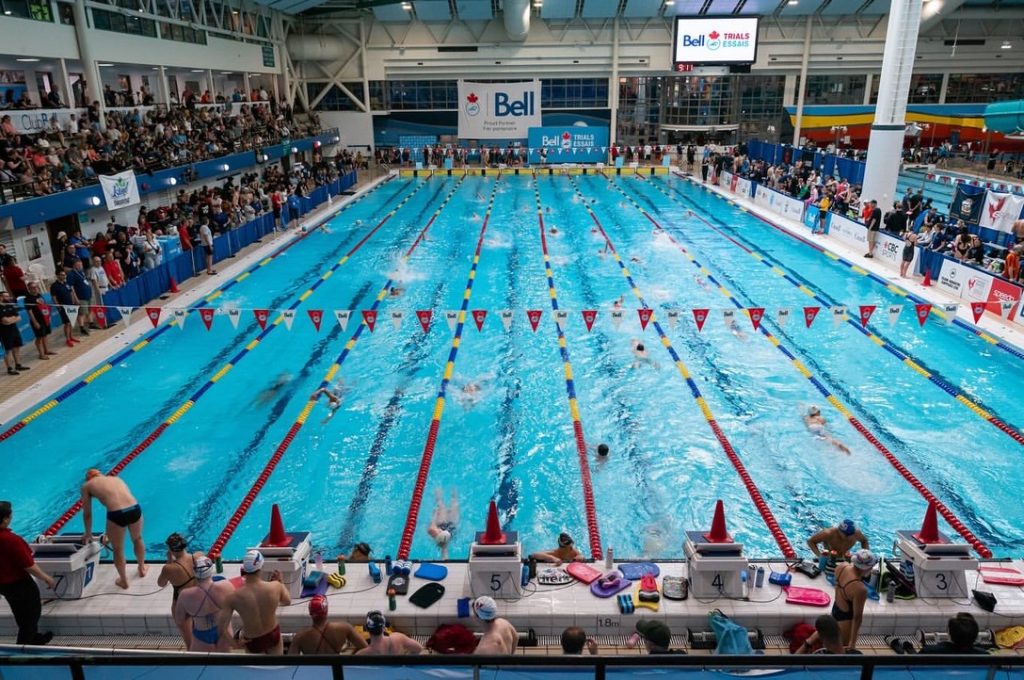
Above: Canadian Swimming Trials Event Facility, 2025, British Columbia, Canada
Overflow Pools: Performance Begins at the Pool Edge
Overflow—or “wet deck”—pools are a familiar feature of modern competition and training facilities. Water passes over the pool edge into perimeter channels, supporting surface-water collection and helping limit the reflection of swimmer-generated waves back into the swimming area.
Combined with effective circulation design and performance racing lanes, this arrangement contributes to a more controlled training and competition environment.
However, the water-level edge also presents design challenges. Starting blocks need secure support at the correct height above the water. Swimmers need clearly defined turning and finishing surfaces. Electronic timing equipment must be accommodated without obstructing drainage or creating difficult maintenance access.
The pool edge therefore becomes an important interface between sporting performance and everyday facility operation.
Anti Wave’s approach addresses these requirements through coordinated equipment systems – from overflow gratings and individual Overflow BlockStands to complete Competition EndWalls and Movable Bulkhead Systems.

Above: Anti Wave Competition EndWall System to suit Overflow Pool event facility, South East Asian Games facility, Philippines.

Above: Anti Wave Competition Equipment, Dubai College, Dubai, UAE.
1. Overflow Gratings: Drainage, Access and Everyday Durability
Overflow gratings perform an essential role in the wet-deck environment. They cover the collection channel while allowing water to pass through, providing a usable poolside surface and access for routine cleaning.
Anti Wave offers two principal systems: TransGrate and LongiGrate, allowing selection to suit the channel arrangement, pool geometry and project requirements.
TransGrate accommodates straight runs and curved pool edges, with corner components available to complete the perimeter. LongiGrate provides an alternative arrangement for straight channels where the support configuration and intended use call for a longitudinal system.

Above: Anti Wave Overflow Pool Grating – TransGrate (left) and LongiGrate models
2. Hitec Competition EndWall System: Precision, Performance and Practical Access
An overflow pool needs a clearly defined interface for starts, turns and finishes. The Anti Wave Hitec Competition EndWall System provides that interface through precision pultruded fibre-reinforced plastic (FRP) construction, integrating starting blocks and timing equipment into a coordinated competition structure.
The EndWall system creates a raised end wall at the required competition height above the overflow channel, supporting competition and training activities while accommodating the pool’s geometry and wet-deck arrangement.
Precision pultrusion produces consistent structural profiles, supporting accurate assembly and coordination of the end-wall face, starting-block positions, timing equipment and surveyed swimming-course dimensions as per current World Aquatics regulation requirements.


Above: Competition Hitec EndWall System competition event venue – RGS Dubai, UAE.
Corrosion-resistant FRP profiles are combined with internal marine-grade stainless-steel fixings and removable, non-slip polypropylene gratings. These materials are selected for sustained exposure to chlorinated water, humidity and outdoor conditions.
The system accommodates major timing platforms, including Omega, Daktronics and Colorado, with equipment mounts, touchpads and cable routes coordinated to suit each facility.
Removable grating sections provide access to the overflow channel for cleaning, maintenance and inspection without dismantling the complete installation. The configuration also allows water movement through the overflow interface, retaining the practical functionality required in a busy wet-deck pool.
Modular construction facilitates installation and, where specified, removal, storage or future reconfiguration. Final dimensions, anchorage, structural requirements and equipment interfaces are developed for each project, taking account of applicable World Aquatics requirements.
For consultants and facility owners, the result is a durable, precisely coordinated competition end wall that combines starts, turns and finishes with equipment integration and straightforward maintenance access.
Above: Anti Wave Competition Hitec EndWall System – South East Asian Games Facility, Philippines.
3. Movable FRP Bulkheads: Reconfiguring the Pool

Above: Anti Wave FRP Moveable Bulkhead System – Excellenfe Since 1982.
A fixed EndWall defines the end of a pool. A movable bulkhead allows the position of a swimming wall to change.
Anti Wave Movable FRP Bulkheads span the pool and can be repositioned to create different training, competition and activity arrangements. This gives operators greater control over how the available water is allocated throughout the day.
Anti Wave’s bulkhead experience includes installations at major international aquatic venues, alongside school, community and national training facilities.
Anti Wave Moveable Bulkheads are produced in close alignment with World Aquatic specifications for competition facility compliance for to
The bulkhead structure uses engineered FRP construction, with materials selected for stiffness, dimensional stability and corrosion resistance. Depending on the project, the system can incorporate starting-block mounts, lane anchors, timing-system provisions, non-slip walking surfaces and access to internal components.
Movement arrangements can include buoyancy-assisted manual positioning or an optional mechanised system. Once positioned, the bulkhead is secured using the specified locating and anchoring arrangements.
Each bulkhead is developed around the actual pool: its width, depth, gutter geometry, deck levels, support conditions and intended operating positions.
Competition-course lengths are coordinated with the bulkhead’s physical width, wall faces and touchpad allowances. This ensures that the proposed layout reflects the available geometry as well as the facility’s programming objectives.

Above: Anti Wave Moveable Bulkhead System – pool programming
4. Submersible SwimWall Systems: Pool Division & Pool-programming flexibility
The Anti Wave Submersible SwimWall System offers another way to make a pool more adaptable.
A SwimWall rests horizontally on the pool floor when lowered. When required, an operator introduces air into its buoyancy system, raising the wall into an upright position where it is mechanically locked for use.

Above: Anti Wave Submersible SwimWall System
This allows a facility to introduce a dividing and turning wall without moving a conventional bulkhead along the pool.
Systems can be configured across part or all of the pool width. Independently operated sections allow different areas to serve different activities—for example, retaining longer swimming lanes beside an area configured for shorter-distance training.
The practical value is the ability to change the pool layout in response to demand. Squad training, lap swimming, school activities and other aquatic programs can be allocated suitable areas within the same body of water.
SwimWalls are manufactured from FRP, with marine-grade stainless-steel anchoring and fittings. Depending on the configuration, provisions allow racing lanes to pass through the wall or connect directly to it, while target markings provide a clearly identified turning surface.
For new facilities, the pool floor can incorporate a recess so the lowered wall sits flush with the surrounding floor. Retrofit installations can also be assessed, taking account of the existing structure, water depth, lowered-wall profile and intended activities.
Every installation requires coordination of the wall position, anchorage, locking arrangements, operating clearances and staff procedures. Where competition use is intended, the complete course geometry and applicable requirements are addressed during design.
For operators seeking greater flexibility from an existing pool—or planning versatility into a new one—SwimWall systems add a valuable programming option.
5. Overflow BlockStands and TurnBoards: Targeted Pool-Edge Solutions
Some facilities require individual starting-block supports rather than a continuous EndWall.
The Anti Wave Overflow BlockStand provides a stable mounting structure across the overflow-pool interface, allowing starting blocks to be positioned at the required installed height.

Above: Anti Wave Overflow Blockstand with Turnboard and SuperBlock 750
Manufactured from durable and corrosion resistant FRP with SS316L fittings, the Overflow BlockStand is designed for demanding aquatic conditions. Its form also allows cleaning beneath and around the structure without routine removal.
An associated GRP TurnBoard provides swimmers with a clearly defined wall surface at the lane end. Available in different widths, it can be selected to suit the pool-edge arrangement and lane configuration.
Together, these components provide a practical solution for facilities upgrading starting equipment or addressing individual lane-end requirements.
The installation is coordinated around finished water levels, gutter dimensions, deck structure and the selected starting-block model.

Above: Anti Wave Overflow Blockstand with Turnboard and SuperBlock
6. Starting Blocks: Adjustable Performance Across the Range
Anti Wave’s starting-block development includes the Moveable Track Start System, developed and patented in 2002. Its adjustable rear-foot wedge allows swimmers to tailor their starting position to their preferred stance – stance – ensuing the fastest performance starts.
That principle continues in the current Anti Wave SuperBlock range.
The SuperBlock 800 is Anti Wave’s premium competition and performance-training platform. It combines a five-position Moveable Track Start System with durable FRP construction, marine-grade stainless-steel fittings, reinforced backstroke handles and a long-life anti-slip top surface. Top colours available as standard in Blue and Red, other colours available.

 Above: Anti Wave SuperBlock 800 with Moveable TrackStart System
The SuperBlock 750 retains the five-position system within a more compact footprint, making it particularly useful where deck or bulkhead space is restricted. It combines a five-position Moveable Track Start System with durable FRP construction, marine-grade stainless-steel fittings, reinforced backstroke handles and a long-life anti-slip top surface. Top colour available as standard in Blue and Red, other colours available.
For general training and competition facilities, the Anti Block 600 provides a durable platform with a fixed track-start wedge and non-slip surface.


Above: Anti Wave SuperBlock 750 with Moveable TrackStart System


Above: Anti Block 600 with Fixed Rear TrackStart and Non-slip tops
Backstroke start ledges are available including our universal model (AWELBH) as well as competition Start Ledges made to suit both the SuperBlock 750 (AWESB7) and SuperBlock 800 (AWESB8).
Across the range, performance depends on the complete installation: platform rigidity, anchorage, height above water, pool depth and timing-system coordination all contribute to a successful result.

Above: SuperBlock 750 with AWESB7 BackStroke Start Ledge in competition
7. Racing Lanes: Completing the Performance Swimming Environment
Pool-edge design and racing-lane performance work together.
Anti Wave 150mm MAXI Racing Lanes are designed for national and international competition pools, elite training venues and major aquatic facilities. The 110mm MIDI range provides a versatile option for training, competition, water polo and general pool division.
Their wave-dissipating geometry is designed to disperse swimmer-generated turbulence along the lane line and down into the water, helping reduce interference between adjacent lanes.
UV-stabilised components, stainless-steel cable and the Anti Wave SuperTensioner support durability and practical installation, tensioning and removal.
Recent competition coverage includes Anti Wave racing lanes at the 2026 Australian Short Course Championships at Sydney Olympic Park Aquatic Centre and the 2026 Australian Age Championships at Gold Coast Aquatic Centre.
The same emphasis on wave control, serviceability and dependable daily use also benefits the club, school and community pools where swimmers train throughout the year.

Above: Anti Wave MAXI Racing Lanes – 2026 Australian Swimming Trials.

Above: Anti Wave MAXI Racing Lanes –Australian Swimming Trials, Brisbane, Australia

Above: Anti Wave MAXI Racing Lanes -2026 Australian Swimming Trials, Brisbane, AUS
8. Teaching and Deck Equipment: Supporting the Whole Operating Day
A versatile pool also needs equipment for the activities surrounding competition and squad training. Learn to swim lessons form an important part of daily pool programming, supporting the next generation of competition swimmers.
The Anti Wave Swim Teaching Platform creates an elevated standing area within deeper water, allowing suitable sections of an existing pool to support supervised learn-to-swim instruction.

Above: Anti Wave Swimming Teaching Platform Model AWESTP2.
Its marine-grade powder-coated aluminium structure, marine nylon connectors and SS316L hardware are selected for repeated commercial use. The AWESTP2 model includes a clear acrylic centre section with non-slip strips, maintaining visibility beneath the platform as required by some regions.
Repositionable upper rails accommodate different teaching arrangements, while the removable format allows the area to return to other uses.
These products help staff manage the transitions that occur every day: lessons to squads, training to competition, and equipment in use to equipment safely stored.
Anti Wave Global: More Than Five Decades of Aquatic Innovation

The strongest aquatic facilities combine sporting performance with practical daily operation.
That requires equipment that can withstand demanding conditions, integrate with the pool structure and support changing activities over a long service life.
Anti Wave Global brings these requirements together across racing lanes, starting blocks, EndWalls, movable bulkheads, submersible SwimWall systems, water polo and pool deck equipment.
Designed and tested in Australia, the range reflects continuing development informed by swimmers, coaches, consultants and facility operators worldwide.
From a school-pool upgrade to a complete International competition venue, Anti Wave’s focus remains consistent: dependable equipment, thoughtful design and greater functionality from the available water.
Anti Wave — Performance and Innovation Since Munich 1972.
Explore the 2026 Anti Wave Global Catalogue, visit www.anti.to, or contact [email protected] for product information, project support and your nearest Authorised Global Reseller.
Anti Wave Global Pty Ltd
Gold Coast, Australia
Email: [email protected]
Web: www.anti.to
Instagram: @antiwave_global