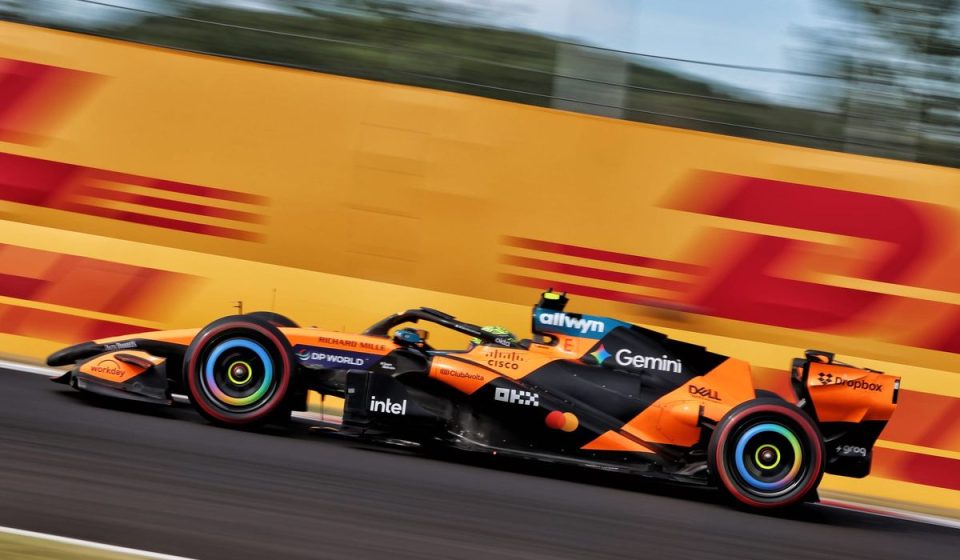

McLaren has admitted it pitched the wheelbase for its 2026 Formula 1 car too short, which will limit the potential of its aerodynamic development until a longer car can be made for 2027.
McLaren has made several admissions over the past month or so that its 2026 car development paths have not been correct, with team principal Andrea Stella saying McLaren is running three months behind its main rivals because of the fact the 2025 title battle went to the wire.
And it would seem one of those development paths relates to the length of the car.
As the team’s technical director for engineering, Neil Houldey, explained to The Race in a semi-exclusive interview, McLaren prioritised the challenge of removing weight from the car under the 2026 rules – and felt a shorter car would be a neat way of achieving that objective – but it came with a cost to the size of floor the car can run with, which has limited the powerful aerodynamic potential of this area.
“Initially, we put a shorter car together because it’s lighter and we knew that the weight regulations were going to be a big, big challenge so that gave us a nice head start and it allowed us to put performance in different areas,” Houldey said.
“Focusing on every little bit of performance often adds a little bit of weight here and there and it allowed us to put a little bit more performance [on the car] because we’d saved that mass up front.
“As we’ve developed the car we’ve taken a little bit more weight out of it. I think for next year we’ll end up with a longer car, because aerodynamically you give yourself a little bit more plan area on the floor.
“As we’ve developed the floor more and more it seems like we can manage that, which initially it looked like actually it wasn’t much of a laptime penalty to shorten the car.”
This isn’t exactly a giant misstep, because after all this is the same length of car that won the recent Hungarian Grand Prix with Lando Norris.
But the fact it’s taken 11 races to get the reigning champion back to winning ways suggests development of the 2026 car has proven more difficult than it might otherwise have been, and the length of the car is clearly part of that equation.
What to expect next from McLaren
Over recent seasons this team has regularly brought big upgrade packages that have worked straight away, but this season it has had to spend more time testing parts in the real world before committing to racing them.
McLaren’s version of the upside down, revolving ‘macarena’ rear wing has yet to race, while the front wing Norris used to win in Hungary was first trialled way back in Monaco, in early June.
A floor update introduced for Hungary, aligned with that revised front wing, finally brought several months’ worth of development together into a winning package.
McLaren readily admits its car lacked aerodynamic load early in the season, but the aerodynamicists needed to find that extra downforce without adding excessive drag to a car the team already felt was excessively draggy.
Efficiency is the name of the game here, which is why the underfloor is once again proving to be such a strong driver of performance – even though the extreme ground-effect designs of recent seasons have been cast aside by regulation changes.
McLaren plans to introduce a new, more efficient rear wing at the Dutch GP – the first race after the summer break – and that aforementioned ‘macarena’ design will probably reappear for the following race at the high-speed Monza.
Understanding the relationship between straight mode – where the car sheds its downforce to improve straightline speed – and corner mode – where the car regains its downforce for the turns – and “where to strike the balance” there “has modified a small amount” for McLaren as the season has progressed, according to Houldey.
“It looks like other teams are sometimes a little bit more efficient than us in cornering mode, in straight mode as well,” Houldey admitted. “So we’re looking at ways of how to make the car more efficient aerodynamically.”
This suggests McLaren perhaps underestimated the importance of its drag targets going into this season, maybe anticipating the new straight mode would be more powerful in mitigating drag than has ultimately proved to be the case.
This new mode hasn’t been enough to totally make up for the energy starvation inherent to the new 2026 power units, and so it follows that any extra aerodynamic efficiency you can find on the car is going to prove beneficial.
Special ops to close Mercedes engine gap
The other part of McLaren’s deficiency in straightline speed in 2026 is the Mercedes power unit – or rather McLaren’s inability to both dictate how it should ideally be operated, and then actually operate it to its fullest extent.
McLaren has talked about this aspect extensively, and it basically amounts to a snowball effect created by a lack of visibility of how best to run the engine that directly results from being a customer team, rather than a works one that can dictate terms to itself.
The gear ratios on the 2026 McLaren are too short, and the reason for that is McLaren based that choice on a projected power curve received from Mercedes that didn’t ultimately match what the power unit actually ended up producing.
As per the regulations, gear ratios are locked in from before the first race and teams are only permitted one (irreversible) change per season. So far, McLaren has opted against deploying this so-called ‘joker’ on the basis it derives benefits from having shorter gears on the slower, less energy-starved circuits.
“If we had our time again, we’d re-ratio to be closer to where Mercedes are,” Houldey admitted. “There are some performance opportunities that we can’t take because the ratios are shorter.
“HPP [Mercedes] won’t know their final power curve until whatever date it might be, which is way beyond after we’ve chosen our ratios.
“We made a good decision with the information we had around us at the time; with the information that we have around us now the decision might be slightly different, but we’re talking milliseconds, not tenths.”
But as we all know, in F1 those milliseconds are worth chasing.
McLaren has invested extra effort into recovering some of the tyre management advantage it held previously but has lost under these rules, adjusting brake duct configurations to better control rear tyre temperatures while working to get the reluctant fronts to fire up quicker.
And on the power unit side, McLaren has created what its performance technical director Mark Temple calls a new ‘power unit performance team’ as it tries to close the gap created by being a customer team that has to work with whatever Mercedes has decided should be the optimum engine settings for a given weekend, without foresight of how those decisions have been reached.
“We have influence on what’s happening within the main programme – but we don’t have guarantees they’ll accept things we request,” Temple explains.
“We’re a little out of the main loop in that respect, working in a side loop that feeds into the programme, but it means we don’t always get the configurations we want and that would suit us.
“In the run-up to a race, we receive information from HPP, but there’s decision-making and evolution we’re not part of. When we find out what we’ve got, there’s often not a huge amount of time to react and respond – so part of what we’re trying to do this year is build and improve our process to make this less of a limitation.
“We have a power unit performance team now, which we didn’t have before. They’ll study track data and work with race engineering, but also use our simulator and offline tools to maximise our performance.
“It’s definitely a new set of skills, and a new way of working – because these are things we didn’t really need to worry about before.”