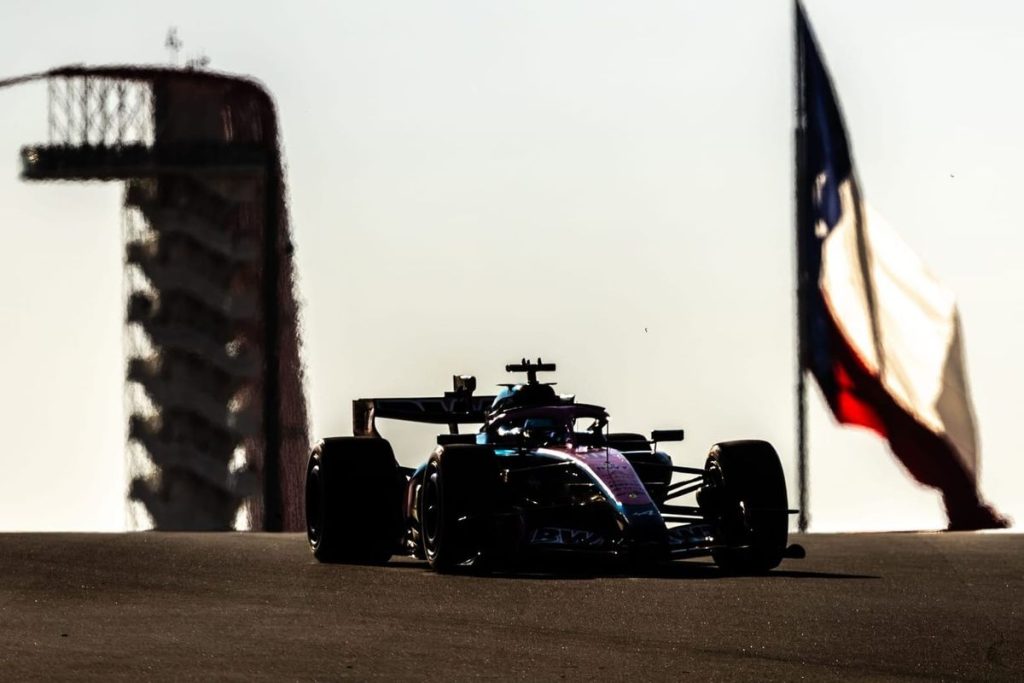
Formula 1 driver-team communication is not to be messed with. And yet this special connection was willingly broken by one team during the United States Grand Prix weekend to facilitate a modern F1 first.
“The driver-engineer radio is the most sacred communication within the team,” Alpine’s IT race communications engineer Rob Gulliver explains.
“It is the most important, it’s the most controlled and it is the most policed. So for someone to come in and have free rein to talk to the driver is a big deal.”
If you were not watching Sky Sports F1’s coverage of opening practice at Austin – or listening to the international feed that takes its commentary – then the post-flag practice starts probably passed you by as normal.
But as the drivers received their instructions to carry out this essential if understated part of weekend preparation, Pierre Gasly’s came from an unusual source.
“Right, you’re coming up to the grid in a few moments,” Sky commentator David Croft told Gasly over the radio.
“I want you to do one burnout, please, and you’re going to start on the right-hand side. And when you’re stationary, Strat 7 for your practice start.
“Did you get that? One burnout, start on the right, Strat 7.”
“You’ve done your homework, I see,” Gasly replied. “So good job.”
Ahead of the US GP weekend, Sky and Alpine collaborated on pulling off a live, two-way, on-track communication after FP1 had finished. Croft was patched into Alpine’s driver radio channel, and conducted a short interview with Gasly answering a few questions after taking the chequered flag and travelling round to the grid.
The above exchange – which was real, not performative, as Croft had to give Gasly the real start procedure instructions, which he called “the most nerve-wracking bit” – then followed. Gasly then gave a brief assessment of the practice start and briefly talked through the run to Turn 1, trying the inside line to scope out how bumpy it was there ahead of Sunday’s actual race start, and the conversation had to be concluded around Turn 2 to leave Alpine and Gasly clear to manage the FIA’s engine mode tests that were incorporated into the end of FP1.
“It’s definitely extra workload to manage when you’ve got Crofty in your ear, chewing your ear around the lap,” Gasly joked to The Race.
“But I think it was nice. It was really cool – the first in F1, so I’m very pleased we managed to get it done.
“I think people were surprised, and it had a positive effect.”
It spanned less than a lap in total, and around two minutes of an atypical radio exchange, but the experiment was complete and a different window into an F1 driver’s practice session had been successfully opened.
“I thought it was a really lovely moment,” Croft told The Race. “I know it’s been done in other series before, but F1 cars are way more complex, way more technical.
“The teams have a set bunch of parameters they need to understand, get right and learn from, because this is their first chance of the weekend to get data from a start on the grid. So we didn’t want to do anything that compromised that.
“But we did want to bring as much as we possibly could to the viewers back home.”
Letting this process be interrupted, even in a very low-risk scenario and at the lowest-stakes part of the weekend, is simply not the done thing.
It’s why F1 has shied away from experimenting more with something so commonplace in British Touring Cars or Formula E – and something that was done in F1 33 years ago when Murray Walker told Damon Hill he had earned pole position for the 1993 British Grand Prix, only to tell him moments later he’d been beaten…
“It’s a leap of faith that we’re actually going to let someone else talk to the driver,” said Gulliver.
“But here we’ve all taken the view that it’s very low risk. We can cut it at any time and regain comms.
“In Formula 1 everything happens at such a fast pace that I need to have confidence in the system.
“I was so nervous listening when I heard Crofty trying to talk to Pierre. I thought, ‘Please make sure he answers, otherwise I’m in trouble!’
“Luckily it went off without a hitch.”
How they pulled it off
The idea was born from a conversation between Croft and Alpine’s communications team, which Alpine racing director Dave Greenwood then got behind. He put it to Alpine’s engineering team and Gasly himself – and nobody said no.
“It’s practice, I’m quite chilled and I know what I’ve got to do, so in terms of actual work done it was the same,” said Gasly. “And it got me a bit of a break from the voice of my engineer!”
Making it a reality was a tougher process though. The conversation picked up during the previous triple-header and at Austin, Gulliver was in contact with Sky from Thursday afternoon until an hour before FP1, installing and testing the systems in conjunction with Sky’s technical personnel, including with the production side back in London.
“The complex hardware, the routing of audio and everything behind it to make this one-minute chat possible was humongous,” he said.
The multi-location effort is best encapsulated by the practice start instruction Croft delivered to Gasly: this originated from Alpine’s engineers in Enstone, was relayed to Gasly’s race engineer, then Greenwood on the pitwall as he was the conduit to Sky. So the instruction went to Sky in the UK, then into Croft’s ear – and finally down the mic to Gasly. All in an extremely quick time.
“It’s an external input into the garage,” said Gulliver. “Our internet provider has access to Sky, and we get a cable from our internet provider to us.
“That goes into a Dante box, which is a piece of audio equipment [on Sky’s side], and that hooks into our system. Then the complex routing of the driver audio to and from is the bit that takes time.
“From a garage perspective, everything internally, from the car to their external box, runs completely through our infrastructure and equipment. Sky are receiving the audio line. Everything else relies on Alpine’s internal network and configuration.”
There is nothing new under the sun, and a recent technology was some source of inspiration in how this could be made to work.
“Back in 2020 we used to do driver of the day, where they spoke to who won that, so I looked back at some of the old logic we had,” said Gulliver.
“That was one-directional, because FOM [Formula One Management] already get our feed, whereas Sky had to be bi-directional.”
Unlike when the team radio is broadcast live through F1TV, which operates on a multi-second delay for censorship in certain cases, this was 100% live and through the direct channel. So there were multiple meetings to ensure it was handled appropriately and, Croft said, Sky added the step of needing him to press a physical button to speak to Gasly so contact could not be made accidentally.
“It’s a proper career highlight,” said Croft. “It’s a bit like when mission control talks to the astronauts in space. You’re pushing technology and pushing the boundaries.
“Sky have been broadcasting since 2012, and we’re always looking to innovate and bring the audience as close as we can to the action, the data, the information.
“You can’t get any closer than speaking live in the cockpit.”
What next
With how much F1 has prioritised the fan experience and trying to unlock as many areas as possible to maximise access to the driver, where this could go next is a fascinating prospect that’s also fraught with the risk of getting too invasive.
The fact the BTCC has regularly had driver comms as part of its coverage on formation laps and behind the safety car could point to an obvious target for a non-racing point of a grand prix. But even for Austin’s innovative duo there is no appetite for that right now.
Gasly laughed when asked by The Race whether he would be up for doing something in the race, like formation laps or behind the safety car a la the BTCC, and said: “No, absolutely not! It still adds extra workload.
“The reality is that this year we have a lot more than in the past, in terms of switches, battery, different strats and modes, etc. We spend so much time on the dash and managing traffic, so there are still a lot of things you’ve got to do.
“Hopefully one day there’s quite a lot less and we have the extra time to have a little chat on our inlaps or outlaps. Not at the moment!”
Croft said similar, wary of the consequences of overstepping. There are moments when team/driver communication is sacred for a reason. And it has to add something, too – Formula E’s post-race communications, for example, are nice enough but they also get in the way of a legitimate moment of emotion between driver and team. A commentary chat should not be above natural, unfiltered reaction in the pecking order.
“Would we love to do a formation lap? Of course,” said Croft. “Would we love to do a chat during a safety car? Of course we would.
“But that is very tricky to do. The safety car is normally out there for a very good reason, and there’s a lot of radio traffic going on during it.
“Could we do it on a slowing-down lap after the race? Yes, but we get a lot of team radio and celebratory moments there.”
So, the sweet spot is finding moments that could give fans some insight and a unique perspective without compromising anything meaningful. Gulliver said it’s “looking at where the risk factor is” – that’s why Sky and Alpine reprised the technology with Martin Brundle literally doing a grid walk alongside Gasly’s car before the race at Austin, talking to him as it was wheeled into position at the end of a reconnaissance lap to the grid.
“Halfway through a session, when they’re going through a plan to try to pick up performance, is probably not the best time,” said Gulliver.
“But laps to the grid, formation laps, all those sorts of places, the stress is less and you know what you’ve got to do. That’s especially true at the end of the session, where you’ve got that whole lap of driving round, which makes it low risk.
“The good thing is we’re able to communicate between us and the production team without Pierre hearing it, so we can drop in and out and figure out the best time for it. But I think it would be quite difficult with drivers behind the safety car and a presenter just starting to talk to them. I don’t think that would work quite as well.
“Pre-planning in certain scenarios would be great. Since it happened, multiple comms engineers up and down the paddock from other teams have told me this is really cool.
“It is really cool, and I’m glad we got the opportunity to try it.”
Croft added: “We’ve done many features where Martin has driven a Formula 1 car and talked us through it. But this time it was a current race driver at a race weekend, and it felt different.
“Watch this space. We’ll see what we can come up with.
“The important thing for me was that the team were happy, Pierre was happy, but most of all that the viewers were happy as well.
“They did enjoy it, and that’s the bit I’ll take from this. We did something that surprised people, and they truly enjoyed the brief glimpse we gave them.
“Maybe we’ll do more in practice sessions, like talking to a driver in the garage while they’re waiting to go out.
“I’m sure there’s more we can do.”