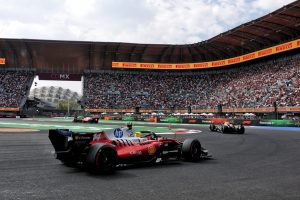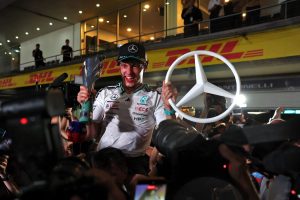
Formula 1’s new champion was crowned amid an action-packed Mexican Grand Prix weekend that taught us plenty.
Here’s everything we learned from the weekend…
Ferrari can’t trust its drivers
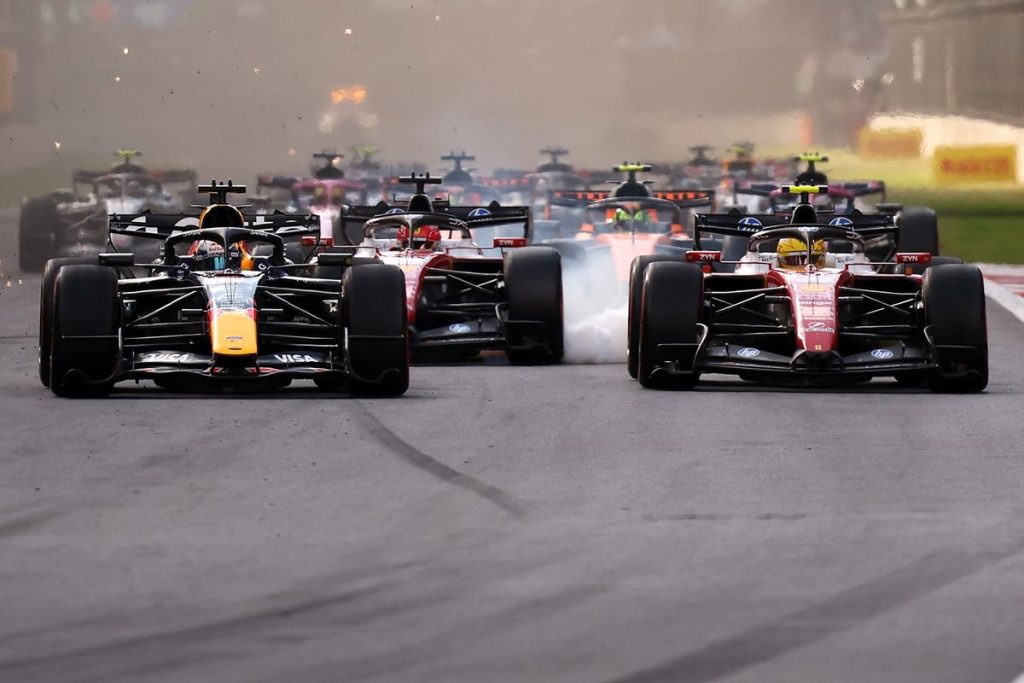
It’s now a pattern of behaviour, and this time it cost Ferrari a very likely win and a probable 1-2. Charles Leclerc’s attack on Lewis Hamilton on lap one and Hamilton’s response to it opened a door through which Max Verstappen happily walked. But it should never have been open at all had Ferrari had a robust team tactics plan in place – or, much more importantly given what unfolded, any hope of trusting its drivers to smoothly execute it.
That lack of trust was the main takeaway from just how the Ferrari situation kept unspooling as Sunday night progressed in Mexico. Every new interview Fred Vasseur did sounded more exasperated. Hamilton’s condemnation of Leclerc’s approach to intra-team racing in general got more blunt as the post-race press conference went on.
“I think it’s a mentality thing. It’s like ‘do or die – either I win or none of us do’, and it shouldn’t be that. It should be us getting that 1-2,” was Hamilton’s most damning line.
But it had also been Hamilton calling for the stewards to penalise Leclerc in the race at a point where Red Bull would have been the direct beneficiary. And they’d both outbraked themselves while fixated on beating each other on lap one. Meanwhile, Leclerc just tried to redirect any angst towards the circuit layout (how careless of the organisers not to barrier-line the track so he couldn’t corner cut to overtake his team-mate) and suggest the intra-team element didn’t really seem much of a “talking point”.
This is a mess. It can be plastered over with some talks or new guidelines. But fundamentally these are two drivers who don’t trust each other to have the team’s best interests at heart, and who are giving their team little reason to trust them. – Matt Beer
F1 escaped an awkward winner
F1 can feel quite fortunate that Leclerc didn’t win the race because he cut the track to gain the race lead.
Thankfully for F1, Verstappen was able to stay just within five seconds of Leclerc and Red Bull cleverly pitted him immediately when Leclerc served his penalty to ensure Verstappen got track position.
Imagine if Leclerc had just a little more pace and had pulled five seconds on Verstappen? Without the red flag/safety car interruptions, he’d have had an easy course to victory…all because he took the race lead off-track.
It once again highlighted a flaw in F1’s rules where unintentionally you’re essentially incentivised to cut a corner, take the position and use your faster car to mitigate any penalty.
There was an element of track layout in this, and The Race understands that proposals for a reprofiled sequence of corners have been put to drivers for potential implementation next year.
But it’s a flaw that had been highlighted before and exists at other circuits.
Leclerc’s penalty was halved because Hamilton also went off the track and it was lap one, but the stewards didn’t penalise Hamilton – so clearly felt Leclerc had done something wrong. Yet the penalty given didn’t even drop him back behind the driver the stewards believed he illegally overtook.
The best way to rectify that in this scenario would have been to order a position swap. It’s tough luck if that also means handing a place back to Verstappen (who had passed Hamilton), but it would at least disincentivise drivers from gaining places off-track. – Josh Suttill
Antonelli is a very popular champion
The ‘Antonelli effect’ this year has been astonishing to witness. He’s so quickly gone from just one of the F1 drivers to one of the most popular.
He’s undoubtedly been devastatingly quick on track, on the podium in all but three grands prix, but there’s been a noticeable impact off-track, too.
Across Monaco, Monza and Mexico in particular, he’s been heralded as a real superstar. At Monza he delighted an Italian crowd even on a day when Ferrari messed up.
And in Mexico you’d really struggle to find anyone who would begrudge his title victory.
The respect from F1 greats Verstappen and Hamilton, who Antonelli shared the podium with, was abundantly clear.
Verstappen said he was “proud” of what Antonelli had achieved, while Hamilton said he was “so grateful to be in the race to witness” Antonelli clinch the title.
Last year’s world champion Lando Norris said Antonelli had “made everyone look silly” with an “unbelievable” season.
Even Mercedes team-mate George Russell, who was fined for missing media duties post-race, was very quick to congratulate Antonelli – and he’s repeatedly acknowledged his team-mate has simply done the better job.
When Antonelli arrived in the media pen post-race, he was greeted by rapturous applause from broadcasters from all around the world, and Antonelli was keen in turn to thank each one.
Antonelli has won his first title without a single controversy or making a single public enemy. That’s not always an easy thing to avoid at the top level of sport, and yet Antonelli has done just that, all while delivering a phenomenally consistent year.
His fellow F1 drivers are best-placed to appreciate that, but they’re all now left with one burning question – how on earth are they going to stop him winning more? – JS
A speed limit ‘ruined racing’?
One of the overlooked quirks of the 2026 regulations that was exposed in Mexico is the existence of what’s effectively a speed limit on these cars.
“The main thing with overtaking is you just have the limiter on,” Lando Norris explained.
“You literally have a limiter that stops you from going over a speed, so it doesn’t matter if you come out of the final corner behind the guy, you just have the limiter on, the same limiter as them, and then you cannot do anything.
“It kind of ruins racing. It’s something that they need to improve for next season. Especially when motorbikes go 370kph and you don’t have a seatbelt or anything, we should easily be able to go quicker than a motorbike.
“This kind of ruined the racing today, and I hope they improve it for next season.”
Hamilton, who spent the final part of the race unable to pass Verstappen, added: “We have this clip at the end of the straight where you can’t go past a certain speed, so everyone just follows.
“It’s the silliest thing when you are behind and you have a little bit more power in the slipstream. You should be able to go past that to have a chance to overtake. The engine can go faster, it’s just they have these silly clips. I mean, it’s the worst engine profile setting that I think they’ve probably ever had in this sport, and it doesn’t provide great racing.”
There isn’t a set speed limit per se with the 2026 cars, but the FIA can restrict maximum electrical power at some circuits.
Article B7.2 of the FIA’s sporting regulations says the FIA provides teams with information on circuit-specific limitations no less than four weeks before a weekend.
This has the sole purpose of “ensuring the maximum speed of the F1 car remains compatible with the design and construction of the relevant circuit”.
This was a factor in Mexico – because the cars are essentially energy-rich there. There’s plenty of recharge opportunities and only one long straight for deployment. Restrictions are in place to stop excessive speeds at Turn 1, but this can have the unintended consequence of drivers topping out at a similar speed at the end of the straight.
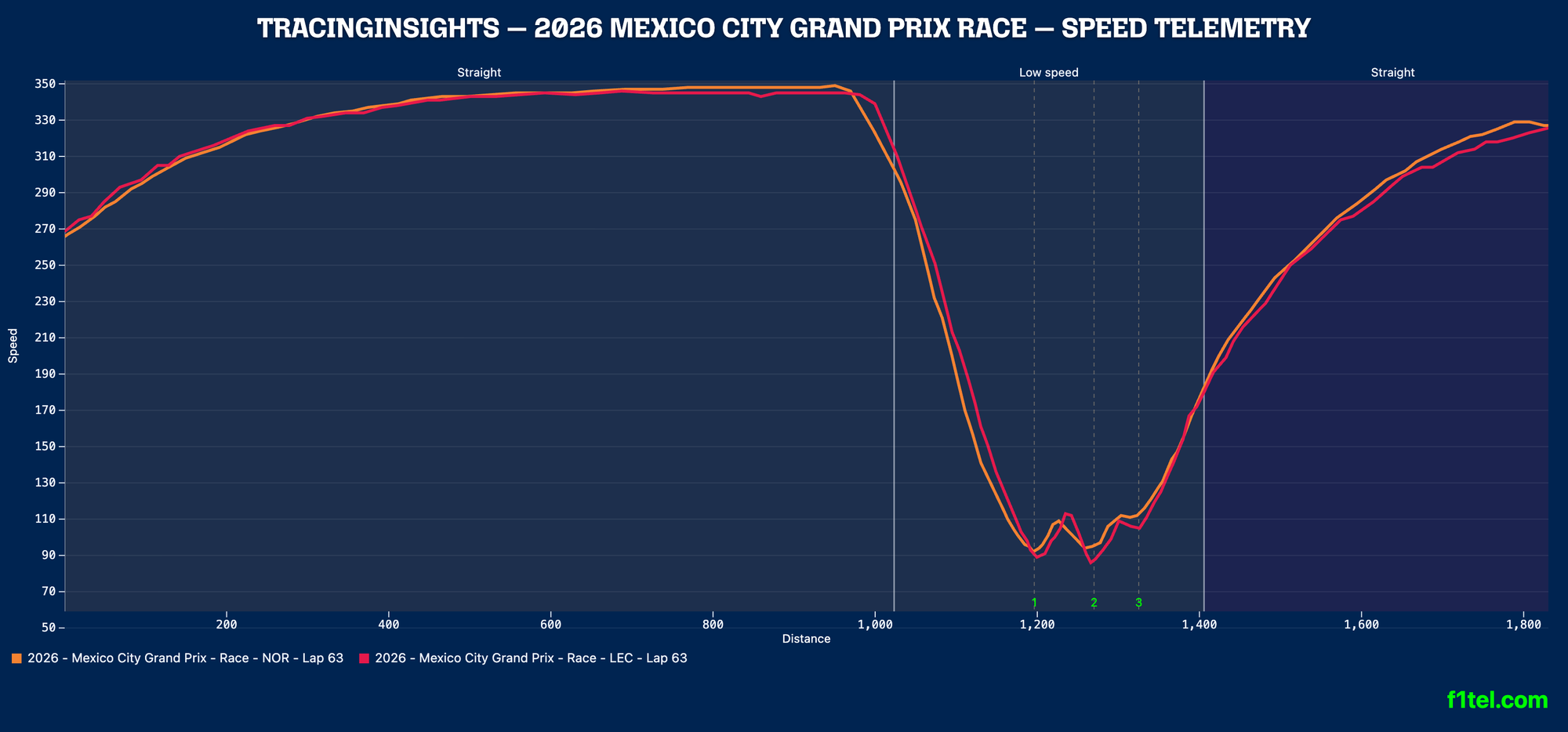
You can see this levelling off in the speed trace of Norris running behind Leclerc en route to Turn 1. – JS
McLaren’s not good enough on Saturdays
That effective speed limit meant Norris couldn’t pass Leclerc, but he was doomed by qualifying on a weekend where Norris believes the McLaren “could have fought for a win”.
That’s a spectacular statement given how scathing Norris was on Saturday after qualifying sixth.
“After I did a good lap in Q2, I knew I was screwed for Q3,” he said. “The chance of me repeating that lap is impossible. It’s just, we’re too slow. Every now and then I can put a magical lap together and everyone has a bit of hope. Which is not a good thing because then we see the reality in Q3 once again.”
Team boss Andrea Stella did allude to his drivers needing to dial back the risk they take with what they know is a knife-edge car – a characteristic that won’t be fixed until 2027 at the earliest.
“This is the material we have and the material we have is more competitive than finishing P6 and P13 in qualifying,” Stella said pointedly on Saturday.
“So, while it’s difficult to get the 100%, at the same time we, team and drivers, have a responsibility to deliver for what we have available.”
Oscar Piastri’s third-place finish in Baku qualifying is McLaren’s only top-three grid position in the five races since McLaren was the team to beat in Madrid.
It has fallen to be the fourth-best team overall since then, but there are plenty of flashes of it looking better than that in the race – which does indeed suggest that McLaren’s underperformance on Saturdays is costing it dearly. – Jack Benyon
Cadillac has a big safety issue to understand
Valtteri Bottas’s frightening crash into the barriers at Turn 1 has given Cadillac a big safety issue it needs to get to the bottom of.
The front-left suspension failure on Bottas’s car is worrying because the team has had previous similar issues on Sergio Perez’s car, namely in Montreal where he retired with a sudden front-right suspension failure.
The team has promised a full investigation into what happened, as on Sunday night, it didn’t have an answer to what exactly caused it.
It wasn’t concerned about a repeat on team-mate Perez’s car – but it’s worrying suspension failures have now happened multiple times this year.
Bottas was excused from his media duties after being discharged from the medical centre, but he was quoted in the team’s press release.
“It was a big impact going into Turn 1, but thankfully I’m okay,” Bottas said.
“Thank you to the medical team for checking me over and to everyone who helped at the scene. It is a testament to the hard work the FIA has put in over many years to make our sport as safe as possible.
“We need to work through everything thoroughly as a team to understand exactly what happened, and make sure we learn from it.”
That’s the fourth time Bottas has failed to see the chequered flag in the last five races, at a time when he’s vulnerable to losing his seat for next year. – JS
Hirakawa’s fortunate debut point was richly deserved
Ryo Hirakawa needed three drivers to be penalised to score a point on debut – the oldest debutant F1 points-scorer of the 21st century at 32. But that doesn’t mean he didn’t deserve it.
After all, Hirakawa was only told he’d make his F1 debut in Mexico via a 6am phone call while preparing for his morning run on Saturday.
And yet he was tracking only three tenths behind team-mate Ollie Bearman in qualifying before a messy traffic-affected final lap left him eight tenths off.
He admitted to finding it a “little bit overwhelming with the others” at his first race start, choosing caution to ensure his F1 debut didn’t end at Turn 1.
But his confidence grew as the race wore on; he passed both Williams cars in the closing laps, which proved crucial when Oscar Piastri and the Alpines were penalised after the race.
Those three drivers all made racing and yellow flag mistakes that Hirakawa avoided at the first time of asking.
Hirakawa was flying by the end of the race, setting his personal best laptime on the very last lap of the race.
It’s a just reward for making an unorthodox path towards F1 work, without the European junior single-seater experience that every single current F1 driver has.
Haas hasn’t decided its driver line-up for Brazil yet, but if this proves to be Hirakawa’s one and only F1 outing, it will stand up as a very solid effort. – JS
‘Hard lessons’ ruin Aston Martin weekend
‘Hard lessons’ was the buzz phrase at Aston Martin this weekend, used by multiple members of the team to illustrate its disastrous event.
The biggest issue was the ERS cooling circuit not working as planned under the strain of high altitude in Mexico on Saturday and Sunday.
Fernando Alonso had a shot at Q2 and was furious when he had to pull to the side of the road, whacking his steering wheel. Both cars retired mere laps into the race with the ERS cooling issue.
This sort of thing, when more common at the start of the year, used to be arguably less worrying because the chassis wasn’t much better than the engine. Now the Aston Martin chassis is good (potentially the class of the midfield at a circuit like Mexico), the engine is really holding it back and an early double DNF on a weekend it might have challenged for points hits hard.
“We did a lot of laps in FP1, FP2 and FP3 as well, then when we got to the moment of truth, quali and the race, we didn’t manage to do enough laps,” said Alonso, who was very much talking a team game after the race.
“But this is part of the process of learning, and hopefully we can learn hard lessons, but we can learn from today.”
Alonso had been 12th in FP2 on Friday and running well until the car stopped running. Honda’s chief engineer Shintaro Orihara said that “we found that our ERS cooling circuit was under heavier stress than anticipated, and this is why we had to stop the car in different sessions”. – JB