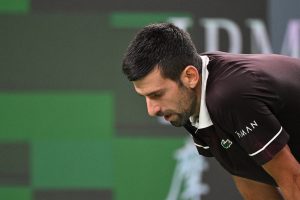
Novak Djokovic has enjoyed an outstanding past eight days of action, which concluded with him winning the China Open for a seventh time on Tuesday.
In the end, his run to the title was incredibly arduous for an ATP 500-level event, with the manner of his victories arguably even stranger than they were tough.
Having struggled through his opening two rounds against lesser opponents, the two-time Grand Slam champion Alexander Zverev posed his biggest threat yet in just the quarter-finals.
Novak Djokovic, rolling back the years, came from a set down to defeat arguably the world’s most in-form player.
However, this match was not without its controversy, and it took just a few games for an argument between the players and the umpire to halt play.
Rank the Australian Open favourites from most to least likely to win as Jannik Sinner ends season early!
The world number one hasn’t played since Wimbledon due to his knee injury… 🚑

In the end, the matter was settled in favour of Zverev, much to Djokovic’s frustration.
Andy Roddick, speaking on the latest edition of his podcast, has now weighed in on the debate surrounding this flashpoint.
Andy Roddick reacts to Novak Djokovic and Alexander Zverev’s umpire controversy
The American pundit sought to stay neutral throughout this conversation, and in doing so tried to see both perspectives of this argument.
As such, he concluded: “They’re all right, by the way. By the way, they disagreed in this moment. That’s not a testy exchange.”
The frustration came as one of the LED advertising boards changed as Zverev served, although three shots were then played before he struck his forehand wide.
Roddick conceded: “You know, it did change, right? And you see that, like, you look at the side, you see that, you have to understand that. That’s why, when people are like, Oh, we can’t walk around during points.
Like, well, it’s not about, like, the actual motion of walking around. We’re trying to track a ball that looks like the size of a pea, and it’s going 140 miles an hour, and you have a quarter of a second to find it, track it, run. So any sort of variance changes that a little bit, right?
“I think that’s what Zverev was saying. But what Sascha says also makes a lot of sense. I didn’t know if I could, so I simply asked after the point, right? If you don’t know that you can challenge something, you wouldn’t be predisposed to challenging it right away. You hit the shot, hoping you make it, and then if you miss it, you ask.
“Basically, Novak was saying the rule is stupid. I don’t disagree with him. Novak was making a judgment on the actual ruling, and it seemed like Sascha was looking for clarification on what he was allowed to challenge.
“But they’re both correct. Like, that’s the ridiculous thing.”
One particular moment during Djokovic’s argument with the umpire did draw an exasperated response from Roddick though, as the 39-year-old questioned whether Zverev could have stopped the point as he did after a 30-shot rally and still forced a replay.
The umpire’s nod drew the following response from the 44-year-old: “Novak’s point about, he can play a 30-shot rally and then challenge it, and the guy went like this? That’s so stupid. No, you can’t.”
In the end, this point was largely immaterial, as Djokovic went on to win the match and the title, beating Daniil Medvedev, who was shockingly defaulted in the semi-final, and Alex de Minaur, who retired injured after losing the first set.