Iga Swiatek has been one of tennis’ more vocal advocates for greater player welfare.
Her devotion to the cause is admirable; it takes a lot to stand up to the faceless powers that be and strive for a better game, not just for herself, but also for generations to come.
What this sport demands from its athletes is superhuman, and it does feel like these demands only increase with each passing year.
Even the decision to extend Masters and WTA 1000 tournaments from one to two weeks, which was done to benefit the players, has only backfired and caused more discontent amongst the players.
This is yet another issue that Iga Swiatek has shared.
Iga Swiatek says she prefers the shorter WTA 1000 tournaments
Speaking after her latest win in Wuhan, she discussed the differences between the one- and two-week WTA 1000 events.
The Wuhan Open is one of the few that remains untouched, with the main draw having started on Monday, and the final due to be played on Sunday.
Where will Iga Swiatek be ranked at the end of 2026?
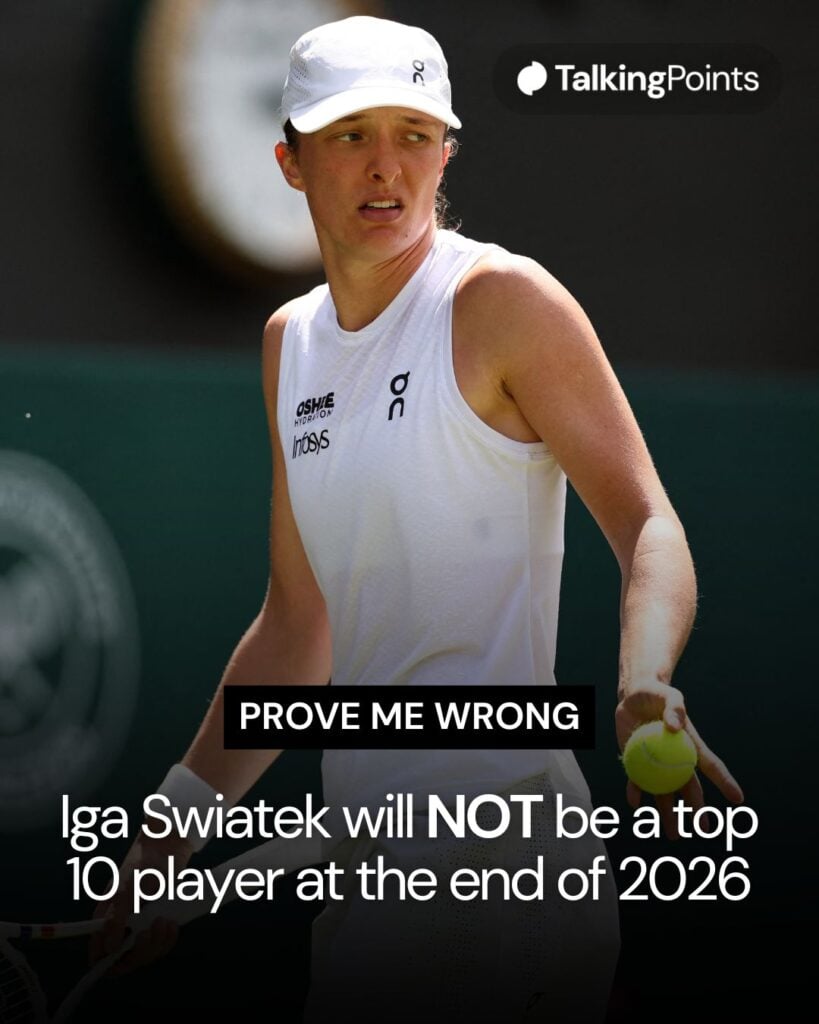
Swiatek admitted: ”Well, honestly, yesterday I played so early that I felt like I had a lot of time to rest, so actually that was helpful.
“For sure, till the end of the tournament, I will have just probably like 24 hours if I keep, you know, playing at 7 pm, um, but I feel good.
“For sure, I liked it with tournaments that were shorter. Obviously, now we’re used to it during our tournament, having this break. So, we need to just, you know, focus on recovery, maybe spend less time, I don’t know, celebrating their win and just switching on to the next challenge.
“But it’s fine. I think that’s better now than actually really waiting and waiting for matches. So, I’m ready.
Despite the schedule, Swiatek will still be desperate to qualify for the WTA Finals, and has a big opportunity to boost her chances this week.
Tennis needs to remove the two-week Masters and WTA 1000 events
At this point, it’s not unpopular to suggest that tennis needs to end this failed experiment. It’s a change that nobody seems to like.
For the players, it stretches out what used to be a one-week event into a Grand Slam-level stay in one place.
Karen Khachanov said it best when, earlier this year, he argued: “Personally, I’m against two-week Masters tournaments. It just feels unnecessary to have nine Masters events plus four Grand Slams – that’s 13 tournaments with a two-week format.”
Naturally, they should come first, with Carlos Alcaraz agreeing that one-week Masters 1000s were far better.

However, it just so happens that the fans suffer as well.
It stretches out the action over a gruelling period, and leaves supporters with maybe one or two blockbuster matches a day, at very most. In the normal format, the pace ramps up dramatically, and it takes no time at all for every showdown to be a thriller.
This unfavourable two-week 1000 event was brutally exposed earlier this month at the China Open, where the men’s 500 event boasted thriller after thriller. Meanwhile, whilst the women played their dragged-out two-week WTA 1000 tournament, these kinds of matches were sparse and sporadic.
The tennis lawmakers’ hearts were in the right place, but this is an experiment that has failed.