U.S. Short Course Trials, Day Three Men’s Finals: Jack Alexy Rips World Record; Luca Urlando and Van Mathias Pop American Marks
The world-record siren could blare again during Night Three men’s competition at the U.S. World Short Course Championships Trials in Westmont, Illinois. One night after he set a world record in the 100-meter breaststroke, Van Mathias will take aim at the global standard in the 50 breaststroke on Friday night at the FMC Natatorium. Mathias led morning qualifying in 25.24, which was good for an American record. The effort also put Mathias within striking range of the world record, held by Turkey’s Emre Sakci at 24.95 since 2021.
In the men’s 100 freestyle, Jack Alexy (45.09) and Chris Guiliano (45.17) set back-to-back U.S. Open records during the morning prelims and will use finals to challenge the world record of 44.84, jointly owned by Aussie Kyle Chalmers (2021) and Russian Egor Kornver (2026). Alexy is the American-record holder at 45.05 and is coming off a runnerup finish in the 50 freestyle, where he placed behind Caeleb Dressel, who is also in the field for the 100 freestyle.
Men’s action will also unfold in the 400 individual medley, 50 backstroke, 1500 freestyle and 200 butterfly, athletes chasing berths to the World Short Course Champs in Beijing in early December. Here is an event-by-event recap of the Night Three events:
Men’s 400 Individual Medley
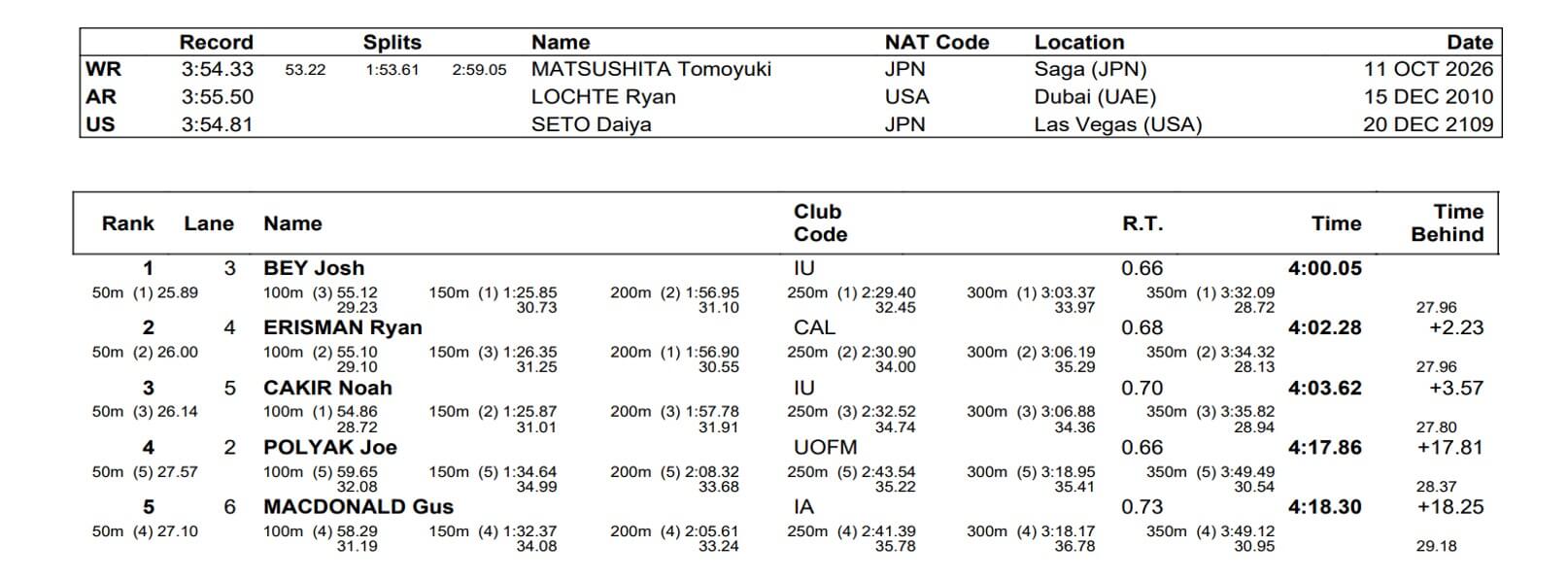
Indiana’s Josh Bey built a nearly three-second advantage following the breaststroke leg and fended over Ryan Erisman on the closing freestyle to earn victory in the 400 individual medley, going 4:00.05. Bey narrowly trailed Erisman at the midway point of the race, but a breaststroke split of 1:06.42 was a difference maker and put the Illinois native in position to win close to home.
“It was a rough year in 2025, and this was my one chance to get on the international stage this year. I managed to do it in the 400 IM, an event I never thought I would do it in. Having it be a hometown glory kind of race too makes it extra special,” Bey said.
Bey just missed breaking the four-minute barrier, but his time was plenty fast enough to defeat Erisman, who touched the wall in 4:00.28. Third place went to Noah Cakir, who turned in a swim of 4:03.62. Erisman now owns a trio of top-three finishes at the meet, as he was the winner of the 800 freestyle on Night One and was third in the 400 freestyle on the second night of competition.
Men’s 50 Backstroke
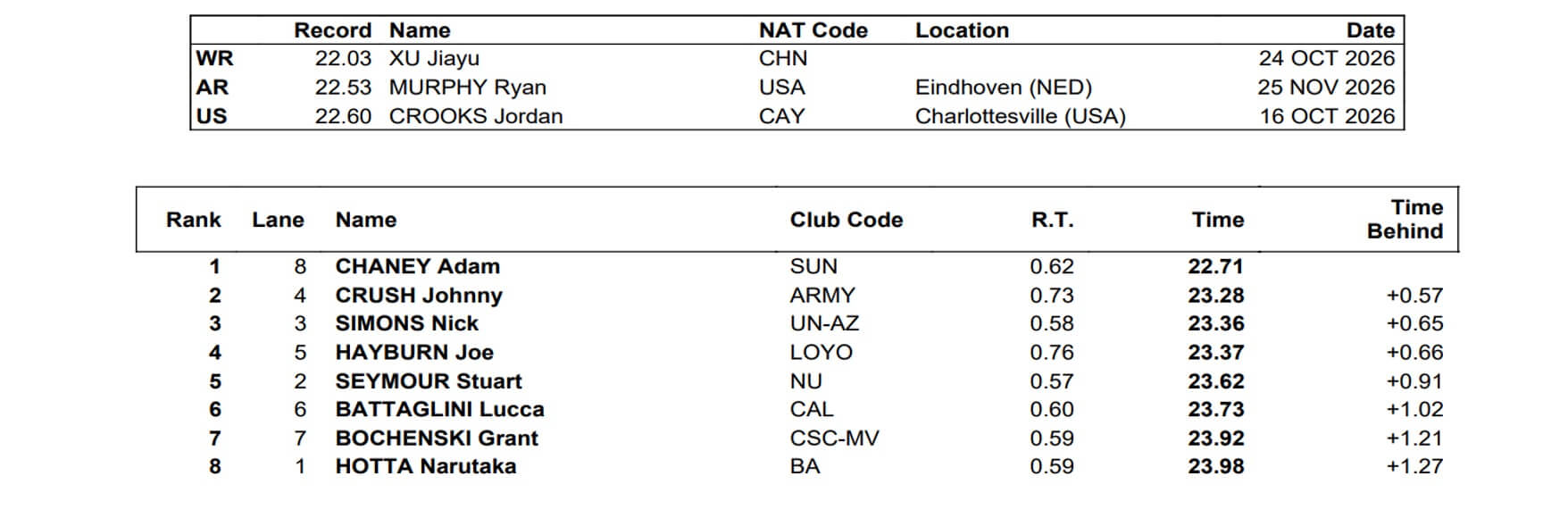
During the morning prelims, Adam Chaney earned the last spot in the final of the 50 backstroke with a 24.00 outing. While he played with fire when it came to returning at night, Chaney left nothing to chance with a trip to the World Champs on the line. Firing off a time of 22.71, Chaney was the convincing titlist, as he got to the wall well ahead of runner-up Johnny Crush (Army), who checked in with a time of 23.28. Nick Simons finished third in 23.36.
Racing out of Lane Eight, the former Florida and Arizona State standout overwhelmed the field during the evening session, surfacing in front of the opposition and building on his lead throughout his two laps. His time vaulted Chaney to No. 4 in history among Americans.
“I got Lane 8 because of my prelims swim. I was just hoping to make it into the finals. I knew I could do it. I honestly thought I could go faster than that, but there is a lot to clean up. It was actually nice because there was nobody in Land 9, so there was fresh water. You have to look at all the positives (in a situation like that). I got to see everyone at turn, too,” Chaney said. “This is the reason I am still swimming, to come to meets like this and make the team. It was actually nice because there was nobody in Land 9, so there was fresh water. You have to look at all the positives (in a situation like that). I got to see everyone at turn, too.
Men’s 1500 Freestyle
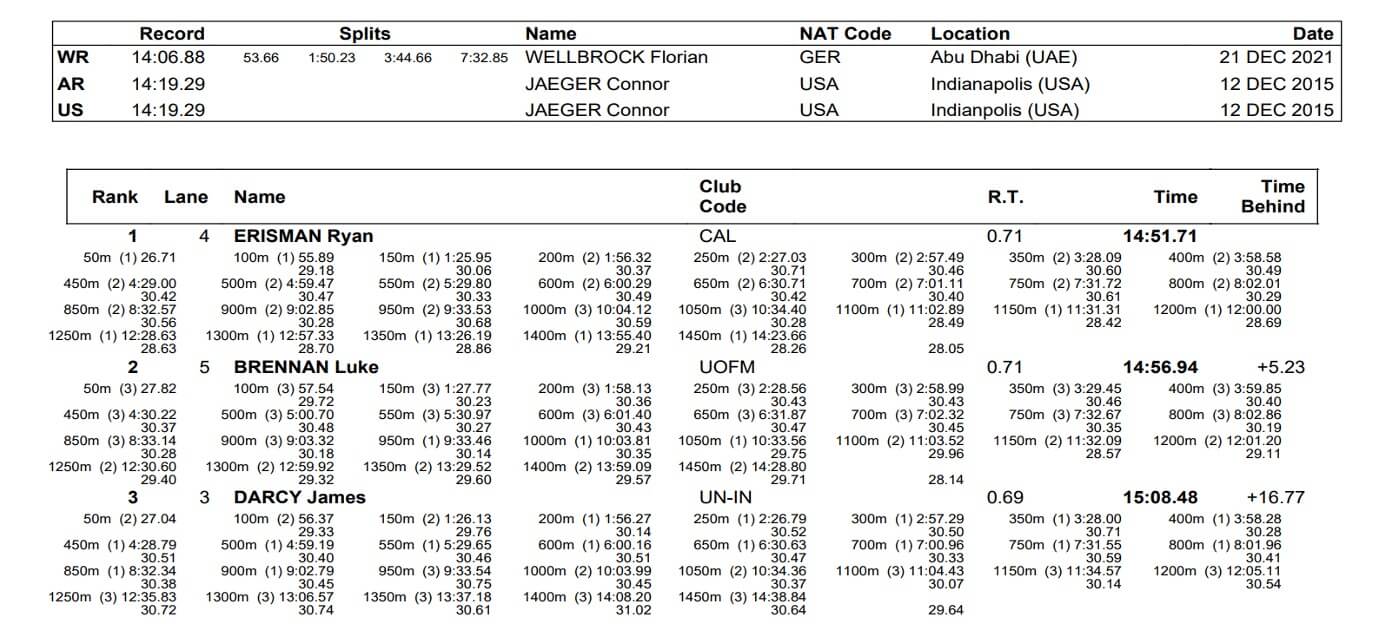
Only three men gave the 1500 freestyle a run at Trials, and it was Ryan Erisman who emerged victorious. The Cal star posted a winning time of 14:51.71 and advanced to the World Champs in Beijing in his third event, complementing the 800 freestyle and 400 IM. The medley event was held about 30 minutes before the 19-year-old Erisman climbed the blocks for the 1500 freestyle, where he was followed in second place by Luke Brennan (14:56.94).
“I am tired, but I feel really good. My sister made the team and that was my favorite part of the night.
I wasn’t really sure what to expect swimming that double. I figured why not? The first 1000 I was just trying to get into the race and that is what I needed to do,” Erisman said. “Luckily I was able to turn it on the last 500 or so. I think I could be way faster if I swim it straight up.”
Men’s 100 Freestyle
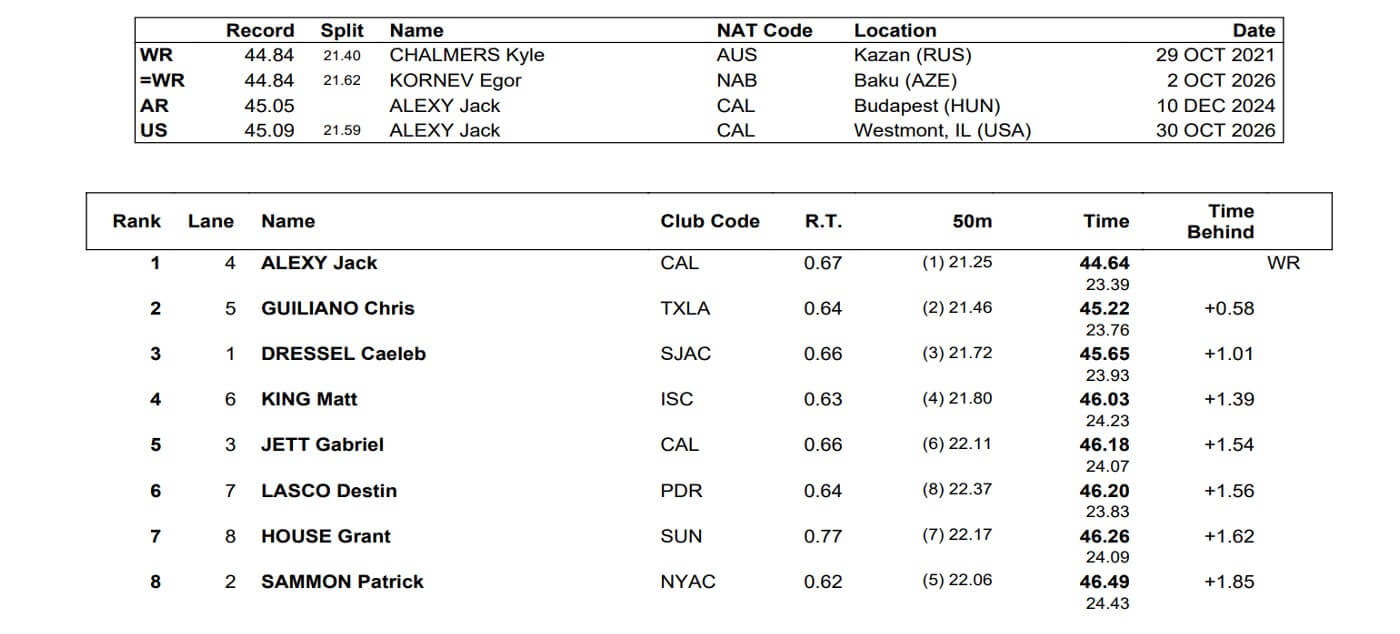
When Jack Alexy just missed his American record in the 100 freestyle during the morning prelims, there was reason to believe a massive performance was ahead for the evening. Indeed, Alexy came through, as he established a world record of 44.64, slicing .20 off the previous record of 44.84, held jointly by Aussie Kyle Chalmers and Russian Egor Kornev. Chris Guiliano was the runnerup in 45.22.
In prelims, Alexy clocked a U.S. Open record of 45.09, which was only .04 shy of his American record. At night, Alexy proved he had a lot more in the tank. The Cal star went out in 21.25, which was .15 under world-record pace, and he came home in 23.39 to easily down the world record.
Finishing third was three-time Olympian Caeleb Dressel, who went 45.65.
More on Jack Alexy’s World Record
Men’s 200 Butterfly
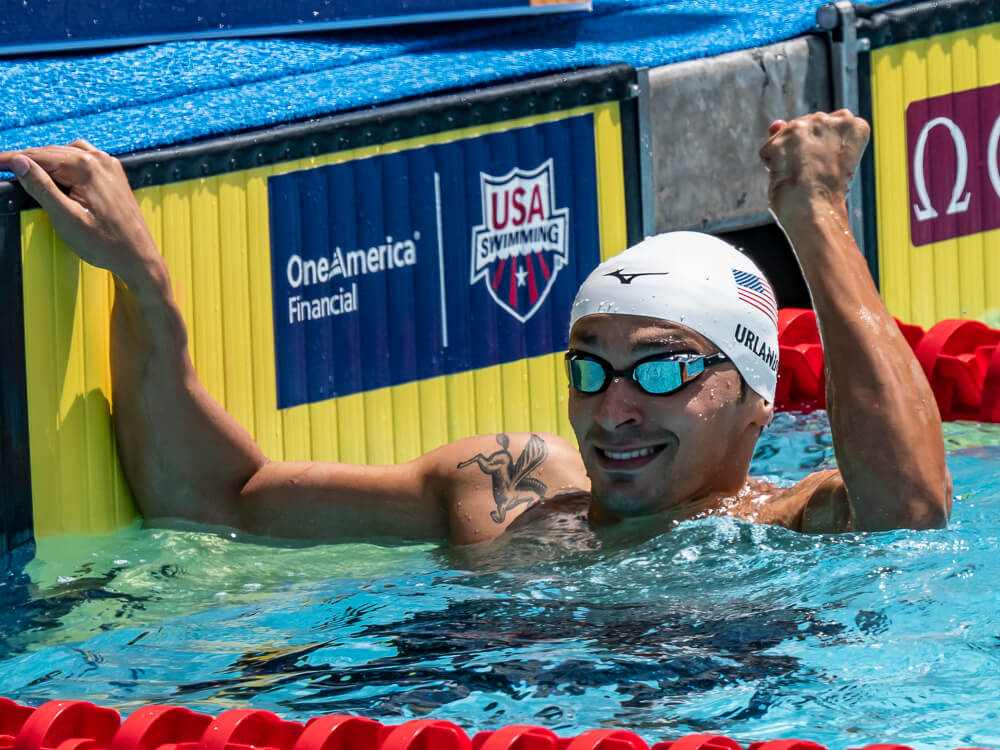
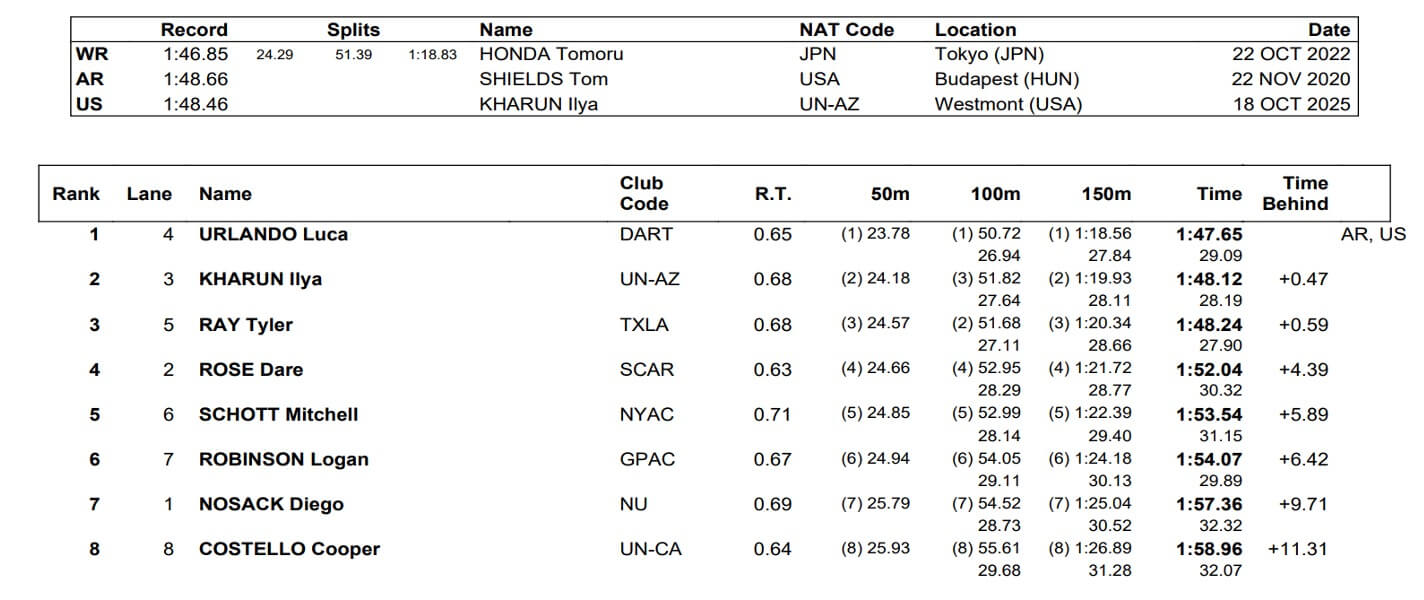
The record run that has defined the U.S. Short Course Trials through three days was evident in the men’s 200 butterfly, as the top-three finishers all went under the American record, with Luca Urlando solidifying himself as the new standard bearer. Coming off a gold medal in the 200 fly at the Pan Pacific Championships, Urlando recorded a time of 1:47.65 to complete a wire-to-wire triumph.
Urlando became the first American to break the 1:48 barrier in the event and took down Tom Shields‘ former American record of 1:48.66 by more than a second. Urlando has clearly confirmed himself the top 200 butterflyer in the United States on the road to the 2028 Olympics in Los Angeles, having previously won the world title in 2025.
“The energy took over and it was a lot of fun racing that. At the 125 I came to my senses again after the adrenaline. I need to dial it back a little bit because that last 50 is getting harder and harder.
Honestly, I just wanted to make the team. All of these events have been so close,” Urlando said. “I will probably feel a lot more satisfied after the meet, but this is where I want to be. It shows I am on the right path through short-course worlds.”
Ilya Kharun and Tyler Ray finished second and third to Urlando, and both went under Shields’ previous American record, which was set in 2020. Kharun touched the wall in 1:48.12, with Ray right behind in 1:48.24. Moreover, the three swimmers climbed the all-time list: Urlando became the second-fastest swimmer ever behind world-record holder Tomoru Honda, with Kharun now ranking third all-time and Ray tied for fourth.
Men’s 50 Breaststroke
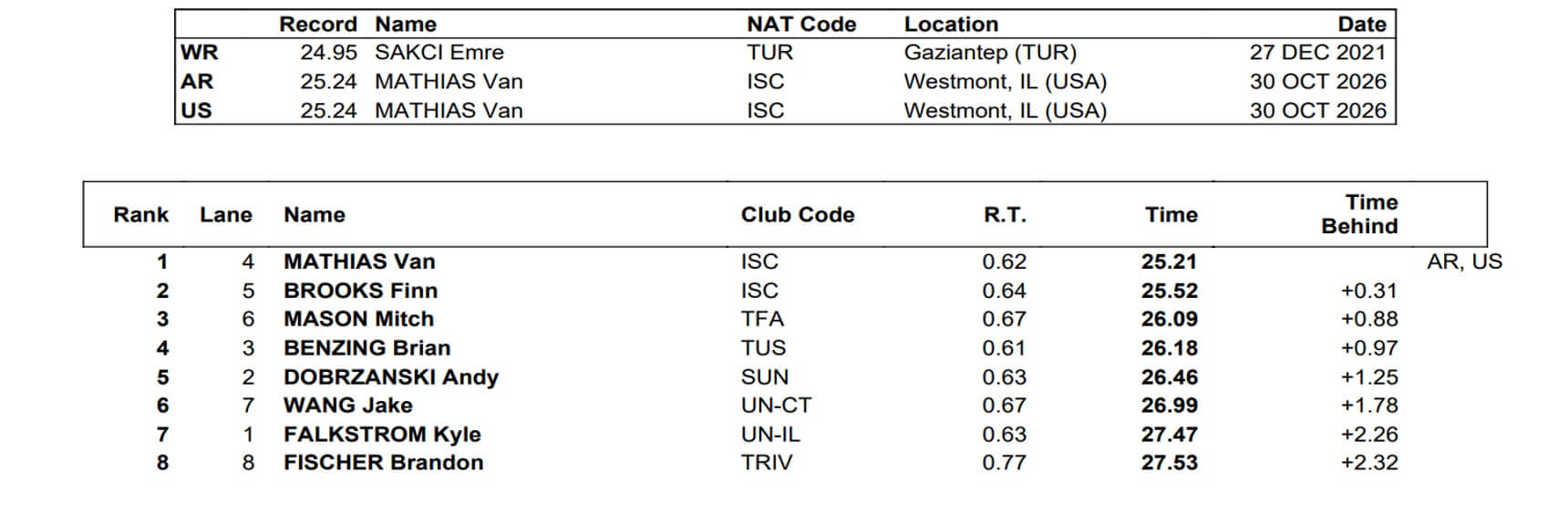
Four breaststroke races and four American records (or more) for Van Mathias at the U.S. Short Course Trials. On Friday night, Mathias lowered his American standard in the 50 breaststroke to 25.21, which was .03 quicker than he went for an American record during the morning prelims. On Thursday, Mathias notched an American record in the 100 breaststroke in prelims, and followed with a world record at night.
Mathias has emerged as the undisputed breaststroke star that USA Swimming needed on the path to LA28 and he will head to the World Championships in Beijing as the big favorite in the 50 breaststroke and 100 breaststroke. Much like Aussie Cam McEvoy has done in the 50 freestyle, Mathias has benefited from a training program that is not heavy on yardage/meters, but focuses on quality work and weight training.
“I kind of want that one back a little bit. My finish was so long. It is something have been working on and just can’t quite piece it together,” Mathias said. “I have to stop being a knucklehead and time up my finish (before Beijing).”
Second place to Mathias went to Finn Brooks of Indiana, as he covered the race in 25.52.