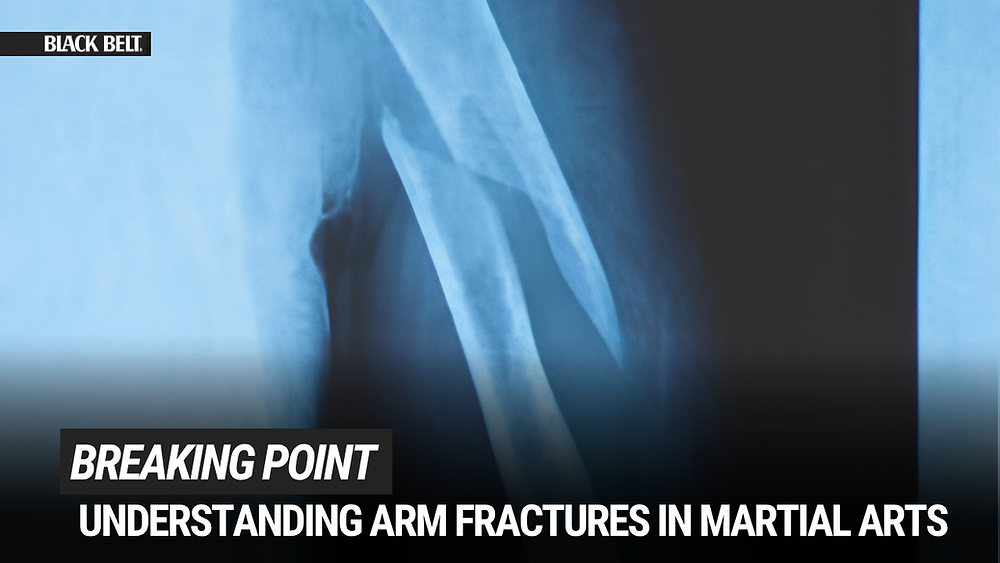
The human arm can break as a result of a blow, twist or lock. The resulting fracture can involve the upper arm, the forearm and/or the shoulder girdle.
An injury to the upper arm affects the humerus bone. At its top end, it forms the shoulder joint with the glenoid, which is part of the scapula. At the bottom end, it forms the elbow joint with the radius and ulna. The humerus is surrounded by muscles that move the shoulder and elbow joints; they include the pectoralis, deltoid, biceps, triceps, brachialis, brachioradialis, and forearm flexor and extensors. Depending on where the humerus breaks, nerves and vessels also may be affected.
At the top end of the humerus is an anatomical region defined as the surgical neck. Fractures above this level are technically considered shoulder fractures. At the bottom end is the supracondylar region; any fracture below it has different considerations and treatment. Because of space limitations, this column will focus on humeral shaft fractures—that is, those that occur below the surgical neck and above the supracondylar distal humerus.
WHEN A PERSON SUFFERS a broken humerus, he experiences immediate pain. The arm may be noticeably crooked, and swelling may be evident. If the bone penetrates the skin, it’s referred to as an open fracture and demands emergency treatment, usually surgery to wash out the wound and repair the break. If the fracture is closed, nonoperative treatment is the norm, but there are exceptions in which surgery is required.
After an injury has occurred, the physician will likely perform a clinical exam of the nerves and blood vessels that lead to the hand. One of nerves that can be injured during a humeral shaft fracture is the radial nerve. At its most distal end, it provides sensation over the top of the hand in the space between the thumb and index finger. The nerve also enables the extension of the wrist and fingers. If the radial nerve is injured, surgical exploration and repair are often called for, perhaps requiring a plastic surgeon.
A closed fracture of the humeral shaft that doesn’t involve nerve injury can generally be treated nonoperatively. Because lots of soft tissue (i.e., muscles) surrounds the humerus, there’s good blood supply to the area. That facilitates healing and means treatment often requires only a functional brace to be wrapped around the limb. It takes a minimum of six weeks for a closed fracture to heal, after which use of the brace can be discontinued and physiotherapy started. The martial artist should refrain from training until the fracture has completely healed and arm functionality has been restored—which can take three months or longer.
CERTAIN CLOSED FRACTURES warrant surgery. The decision to operate depends on how bad the fracture appears in an X-ray. If there’s a big gap between the two ends or severe bending/angulation—or if the two ends are smashed—surgical treatment is often recommended. The surgeon may elect to use plates and screws or a nail to stabilize the bone.
Surgery also may be required if other bones in the same arm are broken—for example, if the forearm or shoulder girdle is broken in addition to the humerus. Such multiple-level injuries are relatively uncommon in the martial arts because of the mechanism and amount of energy that must be imparted to the arm. Note that if a “normal” amount of force causes such a break, the possibility of a pathologic fracture should be investigated. There could be a bone abnormality (e.g., osteoporosis or a tumor) that’s made it weaker than normal.
NO MATTER HOW IT HAPPENS, a fracture of the humerus is dramatic. It will almost always stop the martial artist from training or competing and force him to seek medical attention, and chances are he won’t be back in the dojo anytime soon. For that reason, all practitioners should take care to minimize the risk.
If you apply a technique that targets the arm, do it in a controlled fashion and be sensitive to your partner’s tapout. If you’re on the receiving end, physically or verbally submit before the pain becomes unbearable. Remember that in class you must strive for a balance between creating the intended effect and injuring your partner’s arm.